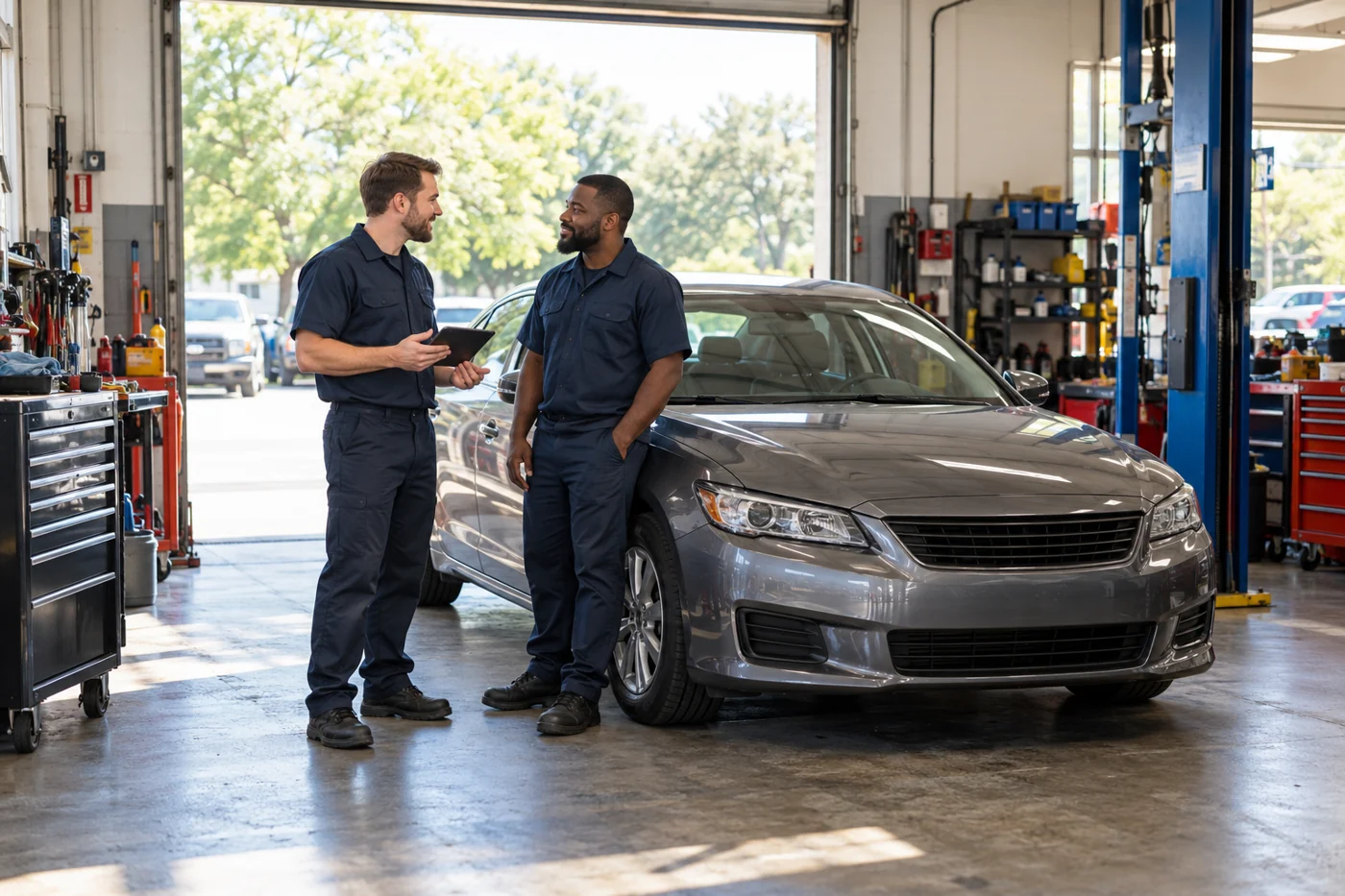
Auto repair SEO helps nearby drivers discover your shop when they search for maintenance, diagnostics, or a repair you actually offer. It combines an accurate Google Business Profile, useful website pages, genuine customer feedback, and a clear way to request service.
Start with the jobs your shop wants and can handle. A driver looking for a brake inspection needs different information from a fleet manager looking for recurring maintenance. Getting either person onto a generic homepage is only part of the task. They still need to understand your capabilities, location, availability, and next step.
This guide is for independent US repair shops and their marketing teams. It explains how to organize local SEO for auto repair shops, improve the appointment path, and measure inquiries through completed repairs. Results depend on your market, website, reputation, and operations; no setup guarantees first place or a full schedule.
Understand where auto repair customers can find you
Your Google Business Profile can appear in local results and Maps. Your website pages can appear in organic search results. Paid ads are a separate channel, and paying for ads does not purchase a better local ranking.
Google's local ranking guidance describes relevance, distance, and prominence. Complete business information helps explain what you do. Distance depends on the searcher's location. Prominence concerns how well known your business is, including signals such as reviews and links.
For a shop owner, the useful question is whether people searching for your actual services can find enough information to contact the right location. Check a few relevant searches from the areas customers come from, while recognizing that results vary by location and context. One screenshot does not establish your position throughout a city.
Choose keywords around work your shop actually performs
List your main services, supported vehicles, and customer types before choosing keywords. Ask your service advisors which requests recur and which jobs the shop declines. That makes the content plan more realistic than pursuing every automotive search term.
The following examples show different needs. They are illustrative queries, not verified search-volume estimates.
| Example search | Likely customer need | Suitable page |
|---|---|---|
| Auto repair near me | Find a nearby shop and check its hours | Main shop or location page |
| Brake repair Columbus | Find a shop offering brake work | Brake service page with inspection and estimate details |
| Car AC repair Columbus | Check whether the shop offers AC diagnosis and repair | AC service page with actual capabilities |
| Honda mechanic Columbus | Find experience with a particular make | A useful make-specific page if that experience is real |
| Fleet maintenance Columbus | Discuss recurring service for business vehicles | Fleet page covering supported vehicles and coordination |
Choose a primary page for each meaningful need. Brake inspection and brake repair may fit on one strong page if they are part of the same service process. You do not need separate pages for every wording variation.
Only target services you offer. A general repair shop should not advertise collision repair, diesel work, EV battery service, or state inspections solely because those phrases attract searches. If a service requires particular authorization or equipment, verify the shop's actual capability before publishing it.
Make your Google Business Profile reflect the real shop
Use a profile your business controls, complete verification through the available process, and check the details against what customers see at the premises. Keep the owner account under your control when an agency helps manage it.
Use the real business name from your signage and other business materials. Adding phrases such as "best mechanic near me" to the name for rankings conflicts with Google's business representation guidelines. Choose the available category that best describes your main business and add only relevant additional categories.
For a garage customers visit, use its actual address, phone number, website, and customer-facing hours. Update holiday hours and explain any separate drop-off arrangements. An overnight key drop does not mean a service advisor is available 24 hours a day.
Add accurate services and recent real photos of the entrance, reception, and facilities. Get permission before showing customers or identifiable vehicles. Pictures should help a first-time visitor recognize the shop; they do not establish a guaranteed ranking improvement.
If you have multiple genuine shops, assess each location's eligibility and link its profile to the relevant location page. Do not create extra profiles for different repair services at the same ordinary shop or for neighborhoods without a real eligible location.
A mobile mechanic has a different setup. A business that travels to customers without receiving them at its address should follow Google's service-area rules, including hiding that address. A shop offering genuine roadside service as well as garage repairs may qualify as a hybrid business. Adding service areas does not turn a fixed garage into a branch in every town listed.
For wider context, see RankVigor's guide to improving Google Maps visibility. Keep your decisions grounded in the shop's real operation and current Google requirements.
Build service pages that answer questions before the call
A useful repair page should explain what the shop can do and how a customer starts the process. It should not repeat a city and service name through paragraphs that say little about the work.
Start with a few priority services rather than publishing a large batch of thin pages. A brake service page, for example, can explain the inspection process, supported vehicles, how the estimate is provided, and how to request an appointment. Have a qualified technician review any statements about mechanical procedures or vehicle safety.
Use this checklist for each priority page:
- Identify the service and the real shop location.
- Explain what is included and any important exclusions.
- State the vehicle types or makes the shop can actually support.
- Describe the assessment, estimate, and approval process.
- Explain applicable diagnostic fees and current warranty terms accurately.
- Add genuine staff or facility photos with permission where appropriate.
- Provide a visible phone number and a clear appointment request.
The FTC's auto repair guidance explains why customers should ask about diagnostic charges, written estimates, and approval for additional work. These are useful topics for your service pages. Describe your own process and have someone responsible for compliance check requirements that vary by state.
Do not invent a starting price to win a click. If you publish a price, explain what it covers and when the vehicle or findings can change the estimate. A page about diagnostics should avoid implying that every warning light has one cause or that an online description provides a confirmed diagnosis.
A fictional title example is "Brake Inspection and Repair in Columbus | Example Auto Shop." Google's title guidance supports descriptive titles; the search result may use different wording. Write a concise meta description that summarizes the actual service and next step. Treat it as useful copy rather than a promise of a particular display.
Link related pages naturally. A maintenance guide can point to the relevant maintenance service; a service page can point to the shop's location and request form. Preserve useful existing URLs unless there is a reason to change them.
Explain your location and vehicle specialties
Your main location page should help someone arrive at the correct premises. Include the accurate address, phone number, hours, entrance or parking information, and available services. Mention after-hours drop-off only with clear instructions and the actual limitations.
A second real shop deserves its own useful location page with its own contact details, staff or facilities where relevant, and service availability. If you have one shop serving drivers from nearby towns, say that those drivers visit the existing shop. A town page does not justify an invented branch address.
Use an additional area page only when it adds meaningful information for customers there. For example, you might explain the route to the real shop and any genuine collection service. Verify such details rather than copying them across a list of towns. Google's spam policies address doorway pages created around similar searches that funnel users to another destination.
Make-specific pages need the same care. Explain the makes and models the shop supports, relevant experience, and available services. An independent shop must not imply it is a manufacturer-authorized dealer without that relationship. Publish EV or hybrid capabilities only when the shop can perform the advertised work.
For fleets, describe supported vehicle classes, how appointments and approvals are coordinated, and who handles billing questions. Do not promise priority turnaround or commercial account terms that the shop has not agreed to provide. The page should help a fleet manager assess fit before contacting you.
Give customers trust signals they can check
Publish the real business identity, current contact details, and a clear explanation of who handles the work. Staff introductions can describe relevant experience without inventing years in business or presenting every technician as having the same credentials.
If you display ASE or other certification claims, verify that they are current and that the wording matches the people and specialties covered. The FTC's guidance also notes that certification alone does not guarantee good or honest work. Avoid turning a genuine credential into a broader unsupported guarantee.
Explain your warranty in plain language, including what is covered and where customers can read the current terms. Do not borrow another shop's mileage or time limits. Use approved examples of actual jobs only when the details are documented and customer permission is appropriate.
Request reviews through a consistent process after a genuine customer interaction. Google's review policies permit requests but prohibit incentives and selective solicitation of positive reviews. Do not offer discounted labor for a review, ask customers for a particular star rating, or send only satisfied customers to Google while redirecting everyone else to a private form.
A simple request can say, "Thank you for visiting our shop. If you would like to share your experience, you can leave an honest review here." Reply without revealing a customer's registration number, repair history, payment details, or dispute specifics. Keep detailed follow-up in the appropriate private channel.
Keep local listings and relevant links accurate
Check the business listings customers use for outdated phone numbers, wrong locations, broken website links, and duplicates. Prioritize details that identify and contact the correct shop. Do not spend the whole month trying to make every harmless address abbreviation identical.
Look for legitimate local and industry relationships: a business association, community organization, supplier, or fleet partner. An accurate listing or useful resource can earn relevant recognition. Memberships should have business value beyond the prospect of a link.
Avoid bulk link packages sold as a shortcut to rankings. For an advertisement or sponsored placement, ask the publisher to qualify the paid link, preferably with rel="sponsored"; Google also accepts rel="nofollow". This qualification describes the placement rather than promising SEO value.
Make the appointment request easy to complete
Check your website on a phone as a first-time customer. Can the visitor tell which location to contact, call the service desk, or request an appointment without searching through several pages?
An initial request can collect a name, contact method, vehicle year/make/model, service or concern, and preferred date. Explain that the service advisor will confirm the details. Collect additional vehicle identifiers or documents later if the service process needs them; avoid placing personal information into analytics events.
If the form sends a request for review, label the button "Request an appointment" and state that the time is not confirmed until the shop replies. If your system books live available slots, explain what is actually booked. Reserving an assessment does not necessarily promise a completed repair by a particular time.
Test required fields, error messages, the confirmation screen, and delivery to the staff responsible for follow-up. Check phone links and any external booking provider. Explain whether walk-ins, towing arrangements, loaner cars, or a shuttle are available only when those services are real.
A missed call is an operational issue even when the website is visible. Record missed requests and response delays so they do not disappear into an SEO report. More traffic will not repair a broken form or create extra technician capacity.
Check that Google can access your important pages
In a verified Search Console property, use URL Inspection to review the indexed status of a priority page and any exclusion reason. The live test checks the current version; a successful test does not mean the page is indexed. Check unintended noindex settings, redirects after changes, internal links, and an existing sitemap if your platform provides one.
Keep service descriptions accessible as page text rather than placing the whole explanation inside an image. Resize large photos for the web and investigate slow or unusable pages on mobile. Follow Google's SEO Starter Guide for the basics and fix confirmed problems before chasing an arbitrary tool score.
Structured data should describe the actual business. Schema.org defines AutoRepair as a car repair business. On a repair shop website, that can be a relevant specific business type, with accurate location details. Google's LocalBusiness documentation lists a physical address and business name as required properties for its LocalBusiness rich-result eligibility. Those are requirements for that Google feature, rather than a rule that every Schema.org description must contain the same fields.
Have your developer check the existing output before adding more markup. Hiding a mobile mechanic's address on a Business Profile does not hide an address written into the website's structured data. If the address is private, avoid publishing it in the markup or inventing a replacement; accept that the page may not qualify for that Google feature. Structured data does not guarantee a search feature or better Maps placement.
Measure inquiries through completed repair work
Use Search Console's performance report to review search queries, clicks, impressions, and priority-page visibility. Separate branded searches from service searches where the available data allows it.
Business Profile performance is a separate report. Google says it includes activity from organic results and Google Ads. A call-button click is not a confirmed conversation, and a direction request is not proof that someone arrived for a repair.
Keep a simple operational record with one inquiry identifier and update its status as it progresses:
- Inquiry date, source, how the source was identified, service requested, and shop location.
- Whether the vehicle and requested work fit the shop's capabilities, plus qualified-inquiry status.
- Appointment requested, confirmed, attended, and completed repair status, with dates for confirmation, attendance, and completion.
- Reason an opportunity was lost, such as an unsupported service or unavailable slot.
Define a qualified inquiry before reporting it. A practical starting point is a genuine request for work you offer on a supported vehicle at a location the customer can use, with enough contact information to follow up. Record date availability separately so demand and capacity are visible.
Do not add calls, forms, appointments, and repair orders together and call the total unique leads. Label unknown sources honestly and distinguish a customer's answer from a source attributed by analytics or call tracking. Agree on attribution rules, test the implementation, and keep sensitive customer details out of reporting systems that do not need them.
When calculating how many inquiries became completed repairs, follow the same group of inquiries through later stages. For example, track October inquiries even if some repairs finish in November. Do not divide all repairs completed this month by all new inquiries this month: they may involve different customers. Keep a separate report of jobs completed during the month for operational planning.
Compare similar time periods and consider seasonality, staffing, hours, and service changes. An increase in completed repairs can have several causes. Report what the evidence shows rather than assigning every change to SEO.
Start with a manageable 30-day work plan
In week one, record the baseline, check the profile and main location details, and test the phone and appointment path. Ask the service desk for recurring requests and lost-opportunity reasons. Save an issue list and agree on the first service to improve.
In week two, revise that service page using the checklist above. Confirm the capabilities, fees, and customer process with the shop. Link it from the service navigation and check its indexing status. Keep a dated record of the URL, change, and checks completed.
In week three, correct important listings and establish a fair review-request routine. If access or indexing problems prevent the priority page from appearing in search, resolve those before expanding the content. Otherwise, publish one useful guide based on a real customer question, such as what information to bring when requesting a diagnostic appointment. Ask a qualified person to review any technical content.
In week four, review inquiries and the appointment process, confirm that the changes work on mobile, and choose the next task from the evidence. Keep the baseline, page checklist, change log, and next-task list as the month's deliverables. This is an implementation plan, not a promise of rankings or repairs within 30 days.
Decide when an auto repair SEO agency would help
An owner can often maintain profile details, collect approved photos, request honest reviews, and improve basic service explanations. Specialist help becomes useful when access, technical problems, multiple locations, content production, or measurement exceed the team's available time.
Ask an auto repair SEO agency to explain which pages and profiles it will work on, who publishes the changes, what information it needs from the shop, and how it will report suitable inquiries. Request a plan that reflects your actual services and capacity.
Compare proposals by scope rather than assuming every monthly fee includes the same work. Separate setup, ongoing SEO, advertising spend, and any extra website work. Keep ownership of the domain, website, profile, and reporting accounts. Treat guaranteed first-place rankings or a fixed number of booked repairs as reasons to question the proposal.
Frequently asked questions
What is SEO for auto repair shops?
It is the work of helping relevant customers discover a repair shop through search. It includes accurate local profiles, useful service and location pages, trustworthy business information, and a working contact path. The outcome to track is suitable inquiries and completed work alongside search visibility.
How can my shop appear for mechanic near me searches?
Maintain an eligible, accurate Business Profile and clear information about the work you offer. Build genuine reviews and relevant recognition. Distance and competition affect results, so there is no setting that makes one shop appear first for everyone.
Do I need a page for every service and vehicle make?
Create pages when they answer a distinct need and you have enough accurate information. Closely related services can share one useful page. Make-specific pages should reflect real capabilities; avoid large batches made by swapping names into the same text.
How long does auto repair SEO take?
There is no fixed deadline. The starting condition of the site, competition, necessary fixes, and customer demand all affect progress. Review completed work and comparable-period results. A 30-day work plan does not guarantee a ranking change.
How much do auto repair SEO services cost?
Price depends on locations, website condition, content, implementation, and reporting. Ask for an itemized proposal explaining setup and ongoing work, responsibilities, extra charges, and advertising costs. There is no single fee that accurately describes every shop's needs.
Should I run ads as well as SEO?
They serve different purposes. Ads may provide paid visibility while SEO work improves the website and local information over time. Assess either channel against suitable inquiries and completed work, and keep its costs and attribution separate. Buying ads does not buy better organic or local rankings.
Choose one service and make its next step clear
Start with a service your shop can deliver well. Confirm the profile and location details, improve the page that explains that service, and test the route from search to appointment request. Record what happens after the inquiry so you can decide what to improve next.
If you need help choosing that priority, explore RankVigor's local SEO services or request a free SEO audit. Use the findings to identify the work that will help nearby drivers understand your shop and contact the right team.