
Plumber SEO helps people in your service area find your plumbing business through unpaid Google results. It combines an accurate Google Business Profile, useful plumbing service pages, a website that works on phones, and measurement that connects inquiries to booked jobs.
Start with the services you want to sell and the places you can reliably reach. Then make it easy for a homeowner to confirm that you handle the problem, check your availability, and contact you. More traffic only helps when those visitors need work your team can actually do.
This guide explains what to prioritize, how to avoid common local SEO mistakes, and what to ask before hiring a plumbing SEO provider.
How plumber SEO works
A search such as “water heater repair near me” can show paid ads, local business results, and ordinary website results. The mix varies by query and location. Your Google Business Profile supports your presence in Maps and local results; your website gives customers more detail and can appear in organic search.
Paid placements are a separate channel. Google Local Services Ads can generate leads for eligible businesses, but buying ads does not purchase a better unpaid ranking. Keep advertising costs and results separate from SEO reporting.
Google describes local ranking through relevance, distance, and prominence. Relevance concerns how well your business matches the search. Distance concerns the searcher's location. Prominence concerns how well known the business is, including information such as links and reviews.
That makes local SEO for plumbers a practical exercise in accuracy and usefulness. Explain your work clearly, build a credible presence, and evaluate visibility in the areas you serve. An agency cannot guarantee that you will appear first across an entire metropolitan area.
Decide which plumbing jobs to target first
Before choosing keywords, list your main services, dispatch area, operating hours, and available capacity. Consider the jobs you want more of, including whether your team handles residential work, commercial work, or both.
A company with limited evening coverage should not build its campaign around a promise of 24 hour emergency service. A company that repairs water heaters but does not install them should make that distinction on its pages.
Use these illustrative searches to connect a customer's need to the right page. They are examples, not verified search volume estimates.
| Example search | What the customer needs | Useful page |
|---|---|---|
| plumber in Raleigh | A local provider and a way to contact them | Homepage or a useful Raleigh service area page |
| emergency plumber near me | Availability and help with an urgent problem | Emergency plumbing page with accurate coverage and hours |
| drain cleaning Raleigh | A provider who handles a blocked drain | Drain cleaning service page |
| water heater replacement Raleigh | Installation options and an estimate | Water heater replacement service page |
| why does my drain keep clogging | An explanation of a recurring problem | Educational guide linked to the relevant service |
Check actual searches and page performance in Search Console when data is available. Also ask whoever answers the phone which services and neighborhoods callers mention. Dispatch records can reveal that a topic attracts inquiries your team repeatedly declines.
Group closely related phrases around the same customer need. “Emergency plumber” and “emergency plumbing service” usually do not need separate, nearly identical pages. Avoid putting every variation into headings or repeating a city name in every sentence.
Set up an accurate Google Business Profile
Find the existing profile for your business before creating another one. Claim or request access where appropriate, complete the verification Google requires, and check whether the profile has restrictions or unresolved ownership issues.
Keep the business name consistent with your real branding. Adding “best emergency plumber Raleigh” to a name that is actually “Oak Street Plumbing” misrepresents the business. Google's business representation guidelines explain the rules for names, addresses, and eligible locations.
Choose categories and describe real services
Select the most specific available primary category that represents your main business. For a plumbing business, “Plumber” is an appropriate choice when it accurately describes the operation. Add only relevant additional categories from Google's available list. Follow Google's category guidance rather than selecting categories as extra keywords. Google may require verification again after a category change, so keep the information accurate and be ready to complete that process.
List services you actually provide, such as drain cleaning, leak detection, or water heater repair. Keep the phone number, website link, and customer-facing hours current. Advertise round-the-clock availability only when your operation can deliver it; a contact form that stays online overnight does not establish 24 hour plumbing service.
Add real photos of your team, vehicles, equipment, and approved work. These help customers understand the business. Treat photography as evidence of your operation, rather than promising a ranking boost from a particular posting schedule.
Handle your address and service area correctly
If customers do not visit your business address, hide that address on your profile and list the areas you serve. A plumber working from a home address should not present the home as a public storefront.
Google's service area guidance allows cities, postal codes, or other supported areas rather than a radius. You can enter up to 20 areas, but choose places your team actually serves. Google generally advises keeping the overall boundary within about two hours of driving time from your base; its business guidelines acknowledge that larger areas can be appropriate for some businesses. This is service area guidance, not a ranking radius. Adding cities is not a guarantee of ranking in them.
Do not create profiles at mailboxes or rented addresses where you do not operate. Separate staffed locations with separate service areas can qualify for separate profiles under Google's rules; each location still needs to be eligible. A larger dispatch territory alone does not justify duplicate listings.
Build service pages that help a homeowner decide
Start with the services that matter most to your business. Depending on your offer, those may include drain cleaning, water heater repair, water heater replacement, leak detection, sewer line work, and emergency plumbing.
Give a distinct service its own page when you have enough useful information to help the customer. A short list of services on the homepage may leave important questions unanswered. Equally, a site does not need a new page for every minor phrase variation.
A useful service page explains:
- Which problems you handle and any important exclusions.
- Where the service is available and how to confirm an appointment.
- What happens during an assessment and how estimates work.
- Current qualifications or licenses that the business can substantiate.
- Relevant project details or photos approved for public use.
- How to call or request an estimate, and when to expect a reply.
For example, a water heater replacement page can explain the equipment types your team installs, what information to have ready when calling, and which factors affect an estimate. It can also answer whether you remove the old unit, if that is genuinely included.
Use a clear title such as “Water Heater Replacement in Raleigh” when the service and location are accurate. Write a readable main heading and a short description that explains the offer. These are content examples, not instructions to repeat the same phrase throughout the page.
Have a qualified member of the plumbing business check technical explanations and service claims. Google's people-first content guidance emphasizes useful, reliable information. Generic promises and copied descriptions give a homeowner little reason to choose you.
Create useful pages for the areas you really serve
A city page can be appropriate even when you do not have an office in that city. It should accurately explain that you travel there and help a resident decide whether your service fits their needs.
Use local details only when the business can verify them. Those might include actual coverage boundaries, available services, scheduling arrangements, or an approved project completed in the area. Do not invent local offices, neighborhood jobs, water conditions, or response times to make a page seem specific.
If you cannot explain anything useful beyond swapping a city name, a clear service area overview may be more helpful than another page. Google's spam policies describe doorway abuse as creating pages for similar searches that put a less useful intermediate page between the searcher and the actual destination. Near-identical city pages that funnel visitors to one usable page are an example. A useful city page should help the visitor directly.
Organize pages so people can browse them. Link the main service area overview to relevant city pages, and link those pages to the services available there. A homeowner should be able to reach the appropriate service and contact information without navigating a chain of repetitive landing pages.
Keep the distinction between website visibility and Maps visibility clear. A useful city page may compete in organic results, but it does not establish a physical office or change your actual location for local ranking.
Make the website easy to find and easy to use
Check your important pages in Google Search Console's URL Inspection tool. They should be accessible to Google, return a successful response, and contain content eligible for indexing. Google's technical requirements explain those basics. Meeting them allows consideration for indexing; it does not guarantee inclusion or a ranking.
Ask your developer to investigate accidental noindex settings, blocked resources, broken internal links, or redirects that lead visitors away from the intended service. Include important pages in your site's navigation and sitemap where appropriate.
Then try the website on your own phone. Can you read the service description, tap the phone number, and submit the form without a popup covering the controls? Confirm that a form submission reaches the right person. A thank-you message on screen is not proof that the office received the request.
Use appropriately sized images and keep the first screen focused on the service, coverage, and contact options. Google's SEO Starter Guide covers clear page organization, descriptive links, and image text. Make those elements useful to the reader rather than treating them as keyword slots.
Where structured data is appropriate, describe the real business and visible information accurately. Google's LocalBusiness documentation includes a Plumber type example and requires a physical address for its supported LocalBusiness feature. Do not publish a private home address just to complete markup or invent an address to pass a test. Have your developer choose an implementation that fits the business.
Structured data does not override Business Profile eligibility or guarantee a special search appearance. Google's structured data policies also require markup to represent the page truthfully.
Request honest reviews and maintain relevant listings
After a completed job, give customers a simple way to leave an honest review, such as Google's review link. Use a consistent request process that includes customers regardless of whether you expect positive feedback. Keep participation optional.
An example message is: “Thanks for choosing us for your plumbing service. If you would like to share your experience, you can leave an honest Google review here.” Add your actual review link before using it.
Do not offer discounts, gift cards, or free services for reviews. Do not send only satisfied customers to Google while directing unhappy customers to a private form. Google's review guidance and fake engagement policy prohibit incentives and selective solicitation of positive reviews. Do not request a particular rating, service keyword, city name, or other specific review content.
Respond professionally without exposing a customer's personal information. Reviews help prospective customers judge the experience; there is no universal review count that guarantees a top position.
Check important business listings for wrong phone numbers, obsolete websites, or false locations. Prioritize directories customers actually use and legitimate local or industry organizations where your business belongs. Membership listings, genuine supplier relationships, and useful community resources can be relevant opportunities when they reflect real participation.
Avoid buying bulk links or paying for placements presented as independent endorsements. A directory count or backlink quota does not establish that the work is useful. Ask a provider to identify the sites, explain their relevance, and disclose any placement fees.
Measure qualified inquiries and booked plumbing jobs
Agree on what a qualified inquiry means. For example, you might count a new customer asking for a service you offer at an address you cover. Exclude job applicants, sales pitches, spam, and requests outside your territory from that measure.
Review the journey in stages so you can see where a problem occurs.
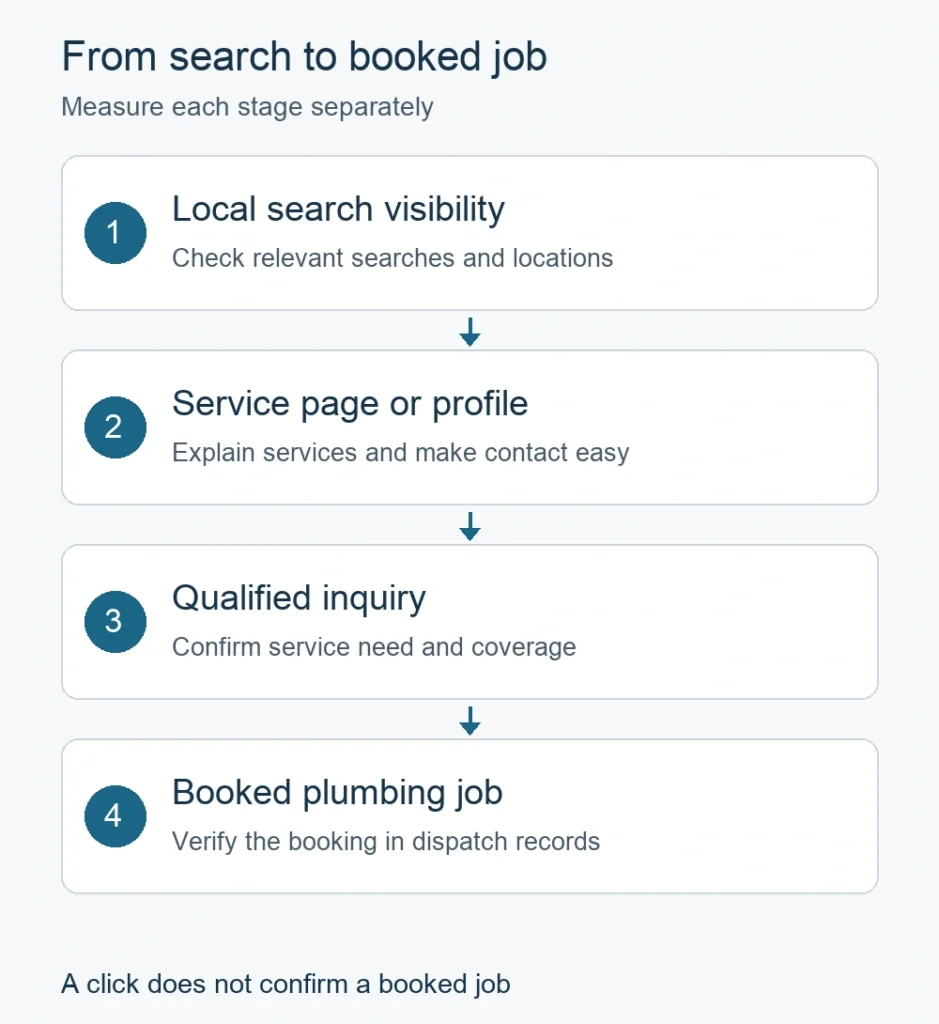
Google's Business Profile performance documentation defines its Calls metric as clicks on the call button. It does not confirm that the phone connected, someone answered, or a job was booked. Profile performance can also include interactions from organic results and Google Ads, so do not treat the entire report as an SEO-only lead total.
Use Search Console performance reports to review organic website impressions, clicks, queries, and pages. Group branded searches separately from service searches when useful. Search Console reports visibility and clicks, rather than completed plumbing jobs.
Your inquiry and dispatch records add the next layer. Record the requested service, approximate service area, known lead source, qualification, booking outcome, and completed job value where available. Avoid storing unnecessary customer details in a shared marketing worksheet.
Count each inquiry once. One person might click from Maps, visit the website, submit a form, and call later. Adding all those interactions together would exaggerate your lead total. Mark an unknown source as unknown rather than assigning it to SEO.
Tracking tools can help when correctly configured. Test website phone links and forms, and verify that any tracking phone number reaches the actual business. Keep the number under business control and document the setup. A phone-link event is still an interaction, not proof of an answered call.
Compare results over consistent date ranges and note changes in advertising, seasonal demand, staffing, or tracking. For Maps ranking checks, keep the query and checked locations consistent; a search from the office cannot represent visibility across your whole service area. Record these conditions so a change in calls or rankings is not automatically attributed to SEO.
Investigate what the records suggest. Relevant visits with few inquiries call for a review of page clarity and contact options. Many missed calls call for an operational fix. Inquiries that rarely become jobs may indicate coverage, availability, or estimate expectations that the website needs to explain better.
Plan the first 90 days of plumbing SEO work
Use this as an illustrative work schedule, not a promise of results by a deadline. A suspended profile, website rebuild, or delayed business approvals can change the sequence.
First month establish a reliable starting point
Confirm the services and areas to prioritize. Check profile ownership and accuracy, establish baseline search and inquiry records, and test the phone and form routes. Fix confirmed problems that prevent customers from finding or contacting you before expanding content.
Second month improve the most important pages
Update priority service pages with verified information. Build a useful service area structure, resolve agreed website problems, and collect approved real photos. Introduce a neutral review request process and correct important listing errors.
Third month review what changed
Check live changes and available data. Look at relevant search clicks, qualified inquiries, and booking outcomes alongside demand and dispatch capacity. Choose the next page or operational issue based on evidence. Keep a record of what changed and when so later comparisons have context.
How to choose a plumbing SEO agency
A provider should be able to explain which plumbing services it will prioritize, which pages need work, and how it will measure useful results. Ask for a written scope that specifies implementation responsibilities. Advice that nobody uploads or fixes cannot improve the live website.
When comparing local SEO services for plumbing contractors, ask:
- Does the scope include Business Profile work, service pages, technical fixes, and tracking setup?
- Who approves plumbing facts, licensing claims, photos, and availability statements?
- Will the team implement changes or supply recommendations for someone else?
- How will it distinguish ad leads, profile interactions, website inquiries, and booked jobs?
- Which accounts and assets will remain under your ownership when the agreement ends?
- What are the fees, exclusions, cancellation terms, and any separate advertising or tool costs?
Ask to see a sample report and a relevant example of completed work. If a case study contains lead numbers, ask how the provider defined and measured them. A ranking screenshot does not establish revenue, and another plumbing company's result does not predict yours.
Google's guidance on hiring an SEO cautions against guaranteed number-one rankings. Be equally cautious about fake offices, purchased reviews, or large batches of near-identical city pages. Our guide to what an SEO agency does explains the work and responsibilities to expect.
Frequently asked questions
What is plumber SEO?
Plumber SEO is the work of improving a plumbing business's visibility in unpaid search results. It includes accurate local business information, useful service and area pages, accessible website content, and measurement of relevant inquiries.
How long does SEO for plumbers take?
There is no fixed deadline. Competition, the website's starting condition, implementation speed, and demand all affect progress. Some website changes can take months to show a measurable effect. Judge completed work and useful trends rather than accepting a guaranteed ranking date.
How much does plumber SEO cost?
Cost depends on the services, locations, website condition, and implementation required. Compare written proposals covering the same work. Ask whether development, content, tracking tools, and paid advertising are included or billed separately.
Can a plumber rank in a city without an office there?
A useful page can compete for organic searches in a city you actually serve. That does not establish a Business Profile location there or guarantee Maps visibility. Explain your coverage honestly and create profiles only for eligible real locations.
Do plumbers need blog posts for SEO?
Helpful guides can answer questions and support relevant service pages. They are not a substitute for accurate service information or working contact options. Prioritize the pages closest to your actual services before committing to a publishing quota.
Is SEO better than paid ads for plumbers?
They serve different purposes and can work together. Ads purchase placements; SEO improves your unpaid presence over time. Compare costs, qualified inquiries, and booked jobs by channel, and account for your available capacity.
Choose your first plumbing SEO priority
Choose one valuable plumbing service and one realistic area. Check your profile details, improve the relevant page, test the contact route, and record what happens to the inquiries. That gives your next SEO decision a practical basis.
If you want help reviewing those priorities, explore RankVigor's local SEO services or request a free SEO audit. Bring your service list, coverage areas, and available inquiry data so the discussion starts with the work your business needs.