
An SEO agency helps potential customers find your business through unpaid search results. It researches what those customers search for, improves your website, creates or updates useful content, and measures whether the work brings relevant visits and inquiries.
Depending on the agreement, an agency may also manage local search visibility, resolve technical problems, and earn relevant links. Some agencies implement changes themselves; others provide recommendations for your team to carry out. That distinction matters before you sign a contract.
When you ask what an SEO agency does each month, you should expect more than a ranking screenshot. You should be able to see which pages changed, why those changes mattered, what happened afterward, and what the team plans to do next.
What is an SEO agency
An SEO agency is a company that provides search engine optimization services. Its work helps search engines understand your website and helps customers find pages that answer their questions or meet their needs.
For a local business, that might mean improving a service page and its Google Business Profile. For an online store, it might mean making product categories easier to discover and fixing duplicate URLs. The work should follow your business model rather than a standard checklist applied to every client.
SEO does not purchase organic rankings. You pay the agency for its work, while paid search advertising buys ad placements through a separate system. Some agencies offer both services, so ask which fees cover SEO and which cover advertising.
The main services an SEO agency provides
Most engagements combine several of the services below. A technical project, a content project, and an ongoing local SEO retainer will have different scopes.
Business discovery and an SEO audit
The agency first needs to understand what you sell, whom you serve, and which inquiries are valuable. A contractor might want more roof replacement estimates rather than a larger number of unrelated calls.
An audit examines the site's existing content, structure, technical health, and search performance. The useful output is a prioritized action plan: which issue matters, which pages it affects, who will fix it, and how the team will check the result.
A long list of tool warnings is not enough. An agency should explain why fixing a problem is worth your time. It should also separate confirmed issues from recommendations that need more investigation.
Keyword research and search intent
Keyword research identifies the phrases potential customers use and the kind of answer they expect. Search intent is the purpose behind the query: learning something, comparing providers, finding a nearby business, or making a purchase.
For example, “how long does a roof last” calls for an explanatory guide. “Roof replacement in Raleigh” calls for a relevant service page. Publishing the same type of article for both would miss an important difference.
An agency should connect each topic to an existing page or a justified new page. It should prioritize relevance and business value alongside search demand, instead of chasing high-volume terms your business cannot serve.
Technical SEO
Technical SEO addresses problems that prevent search engines from accessing, understanding, or indexing the right pages. Work can include correcting accidental noindex settings, repairing broken internal links, managing redirects, and improving navigation.
The agency may also review duplicate URLs, mobile usability, and loading performance. Structured data can describe relevant content, but adding markup does not guarantee a rich result or a ranking improvement.
The important deliverable is a verified fix. If the agency supplies a developer ticket, someone still needs to implement it and check the live page. Google's SEO Starter Guide explains these fundamentals and why changes take time to evaluate.
On page improvements and useful content
On page SEO improves what customers and search engines encounter on a page. An agency may rewrite a vague title, organize headings, improve service descriptions, and add relevant internal links.
Content work can mean updating a strong existing page rather than publishing another blog post. A service page may need clearer coverage areas, a useful explanation of the process, accurate qualifications, or real project photos supplied by the business.
Google's people-first content guidance emphasizes usefulness, reliability, and original value. An agency should ask for your expertise and check factual claims before publishing. Neither a high word count nor a large batch of AI drafts substitutes for that work.
Our guide to thin content and helpful content offers a starting point for reviewing what your pages actually contribute to a reader.
Local SEO and Google Business Profile management
For businesses serving a local area, an agency may maintain accurate Business Profile information, improve location and service pages, check business listings, and help organize a review response process.
Google describes local ranking in terms of relevance, distance, and prominence. An agency can improve the accuracy and usefulness of your presence, but it cannot change a customer's distance from your business or buy a better local ranking.
If you serve customers locally, our local SEO checklist shows the types of tasks to discuss. Confirm whether Business Profile work is included in the proposal rather than assuming every SEO package covers it.
Relevant links and outreach
Some agencies help your business earn links through useful resources, relevant partnerships, industry publications, or genuine news. The work may involve researching opportunities, creating a resource worth referencing, and contacting an appropriate publisher.
Ask what outreach includes and whether placements are guaranteed. Editorial decisions belong to the publisher. A promise to deliver hundreds of inexpensive links deserves scrutiny, especially if the agency will not identify the sites or methods.
Google's spam policies prohibit link schemes intended to manipulate rankings. A good agency should explain its approach and distinguish advertising or sponsored placements from editorial links.
Measurement and ongoing improvements
An agency reviews what happens after changes go live. Search Console helps show which searches and pages generate impressions and clicks. Analytics and your sales records can help connect website visits to inquiries and sales, subject to how tracking is configured.
The team should investigate changes in context. More traffic from irrelevant searches may not help your business. A seasonal slowdown or broken tracking can also make a simple month-over-month comparison misleading.
The next round of work should respond to evidence: improve a page with relevant impressions but few clicks, resolve an indexing issue, or clarify a service page that attracts visitors who do not inquire.
What to expect from an SEO agency
A useful proposal names the work, the people responsible, and the outputs you will receive. The examples below are possible deliverables, not a universal package or a required monthly quota.
| Work area | Example deliverable | What you can check |
| Audit and planning | Prioritized issues with affected URLs | Clear reasons and implementation owners |
| Keyword research | Topics mapped to service pages and guides | Relevance to your customers and offer |
| Technical work | Completed fixes or developer tickets | Live changes and follow-up checks |
| Content | Approved page updates or new drafts | Accuracy, usefulness, and publication status |
| Local SEO | Profile updates and a listing cleanup record | Correct details on the relevant listings |
| Outreach | Opportunity list and activity record | Relevant targets and transparent methods |
| Reporting | Results, work completed, and next priorities | Metrics connected to business goals |
Before work starts, clarify who writes content, who approves it, and who uploads it. Ask whether development time, design, photography, tracking setup, and third-party tool fees are included.
You should retain ownership of your domain, website, Business Profile, and measurement accounts. Provide appropriate user access to the agency. That makes the relationship easier to manage and allows another team to continue if you change providers.
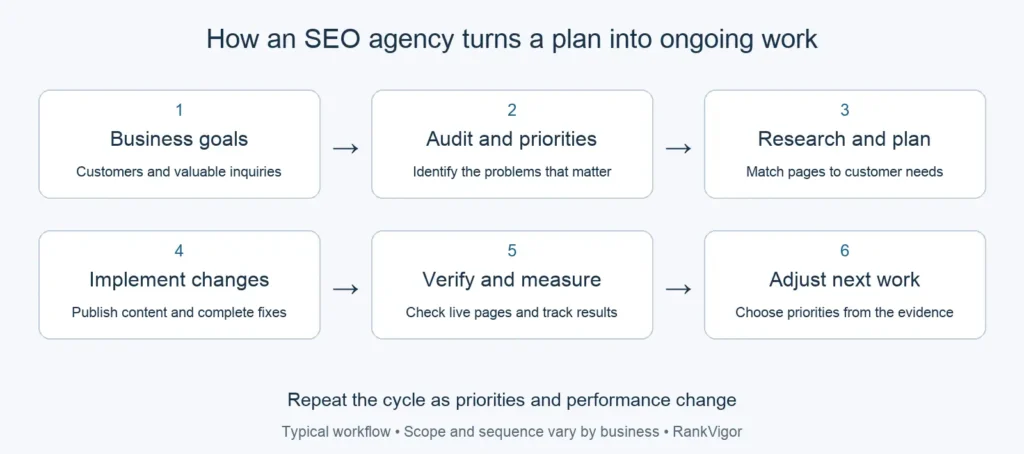
What an SEO agency might do in the first 90 days
The following is an illustrative plan for a small service business. It describes a possible sequence of work, not a promise of rankings, leads, or a fixed agency schedule.
First month establish the baseline and priorities
The agency learns about the business, reviews available data, checks whether measurement works, and identifies the most important pages and obstacles. The output should be a plan you can understand, including any approvals or developer work needed.
For example, it might discover that a valuable service page is accidentally excluded from indexing. Resolving that issue could take priority over writing four new articles.
Second month implement and verify
The team fixes agreed issues, updates priority pages, and works with the business on content and local information. It records publication dates and checks that changes reached the live site.
If development access or approvals are delayed, the agency should explain what is blocked and how that affects the plan.
Third month review and adjust
The agency reviews early search and inquiry data, explains what can reasonably be inferred, and selects the next priorities. Some work may need more time to produce measurable changes.
There is no universal SEO deadline. Competition, site history, demand, implementation speed, and the type of changes all affect progress. Google's Starter Guide notes that effects can take from hours to months and that some changes may have no noticeable impact. Evaluate completed work and meaningful trends rather than expecting a guaranteed result by day 90.
What should be in a monthly SEO report
A report should answer three questions: what changed, what the data shows, and what happens next. It should also identify anything waiting on your team.
Ask for a short summary of completed work with links to changed pages, followed by relevant search and business measures. Google's Search Console performance report explains impressions, clicks, click-through rate, and average position. These describe search visibility; they do not independently establish revenue.
For a service business, qualified inquiries and booked jobs are often more useful than total visits. Agree on what counts as a qualified inquiry and how the agency can access that information. A submitted form is not automatically a customer.
An illustrative update might say: “We updated the replacement service page and corrected its contact form tracking. The page is receiving relevant search clicks, but tracking was only repaired midway through the month, so inquiry comparisons are incomplete. Next, we will review the call to action and collect approved project details.”
That gives you a basis for a decision. A screenshot showing that a keyword moved from position 18 to 12 leaves much more unexplained.

Do I need an SEO agency
An agency can be useful when search is an important source of customers and you need expertise or time your team does not have. It may also help with a site migration, a growing location network, or a technically complex website.
You may be able to handle the basics yourself if your site is small, your needs are straightforward, and you can consistently maintain accurate information and useful pages. A one-time consultant or technical project may be a better fit than an ongoing retainer for a specific problem.
Before committing, consider whether you can supply subject knowledge, approve changes, and follow up on leads. An agency cannot correct an unclear offer or a slow sales response through rankings alone.
The right question is whether the proposed work addresses a real business need at a cost you can sustain. Paying for an agency is not a requirement for appearing in organic search.
What SEO agencies do not automatically include
SEO is one part of marketing. Paid advertising, social media management, a complete website redesign, customer service, and sales follow-up are separate responsibilities unless the contract includes them.
Website changes also need an agreed scope. An agency may identify a slow template while a developer handles the rebuild. Similarly, a content plan may require a photographer or input from your staff.
An agency cannot guarantee a number-one Google ranking. Google's guidance on hiring an SEO advises against those promises and encourages clear explanations of proposed changes. Be cautious when the provider promises results but cannot explain the work.
Frequently asked questions
What does an SEO agency do every month?
The team implements agreed improvements, develops or updates content, checks performance, and adjusts priorities. The mix depends on the site and contract. Ask for a record of completed work rather than assuming every month must contain the same number of posts or links.
How much does an SEO agency cost?
Fees depend on scope, market, site complexity, locations, and implementation responsibilities. Agencies may charge a retainer, project fee, or hourly consulting rate. Compare written scopes and exclusions, not just the monthly price.
Is hiring an agency better than doing SEO yourself?
It depends on your skills, available time, and the work required. An agency offers additional capacity and expertise; you still need to contribute business knowledge and approve factual claims. DIY work can suit a smaller, simpler site.
Does an SEO agency write blog posts?
Some do, while others provide briefs for your writers. Ask whether research, writing, editing, images, and publishing are included. The content plan should support customer needs and existing service pages rather than treating blog volume as the goal.
Can an SEO agency improve visibility in AI search?
It can work on accessible pages, useful answers, and accurate business information, and monitor visibility where tools allow. Google's AI search guidance says its existing SEO fundamentals remain relevant and that special schema is not required for its AI features. No agency can promise inclusion in a particular AI answer.
Understand the work before you hire
An SEO agency should make the plan and progress understandable. You should know which customer needs it is targeting, which pages it is improving, and how you will judge whether the investment is helping.
If you want a starting point for your own site, request RankVigor's free SEO audit. You can also review our SEO services to see how local, technical, and content work fit together.