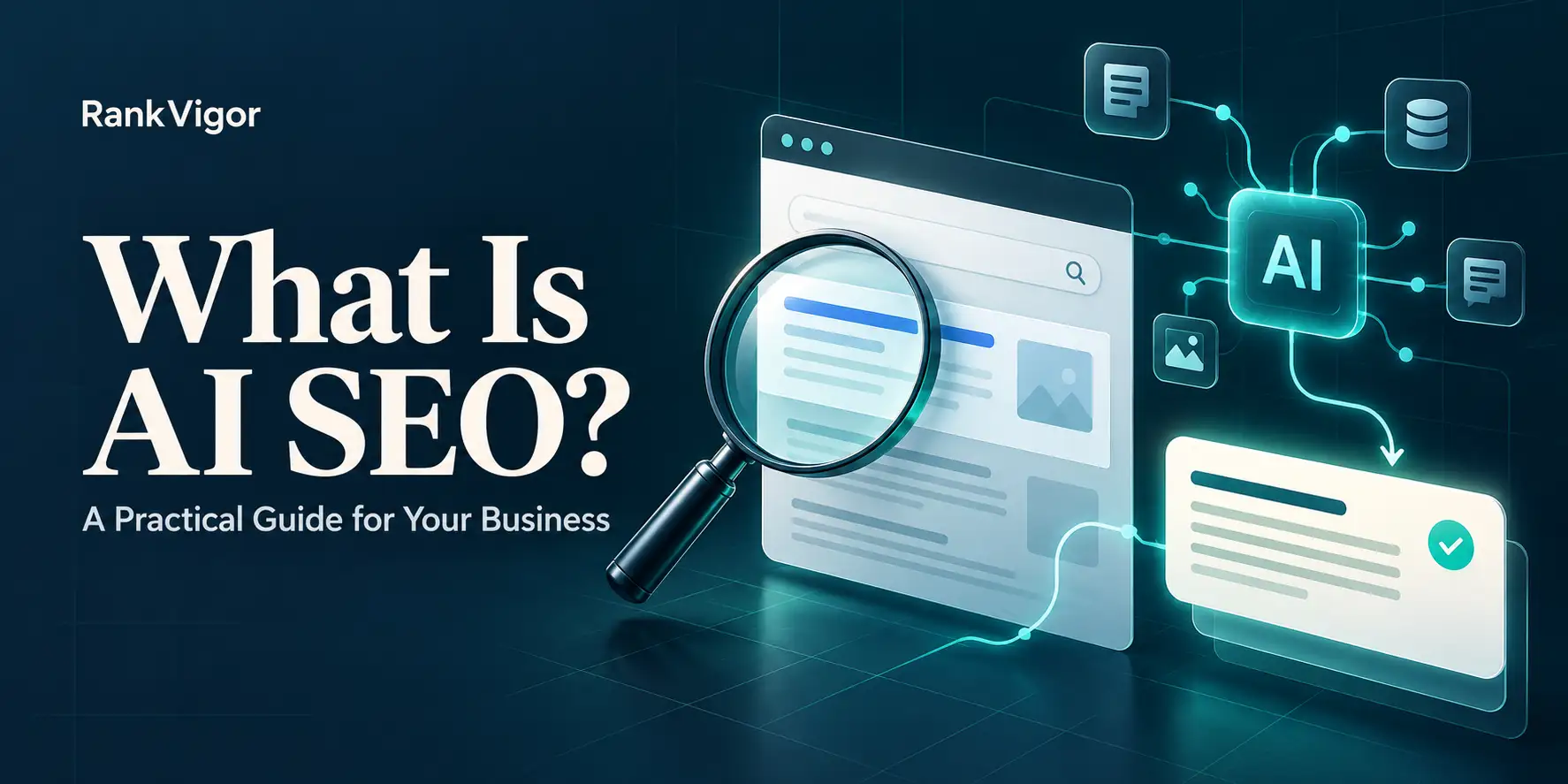
What is AI SEO? It means using artificial intelligence to support SEO work and improving your website’s visibility in AI-powered search experiences. The goal is to help people discover useful information about your business and take the next step.
Search is changing. Customers can explore a topic through traditional results, AI summaries, and conversational answers. For a small business, the practical question is the same: can people find reliable information about what you do, and does it help them take the next step?
At RankVigor, we focus on real rankings, real traffic, and real leads. We run our own blogs as well as working on client sites. This guide explains the two sides of AI SEO, what you can improve today, and how to measure progress without mistaking a mention for a sale.
What is AI SEO used for?
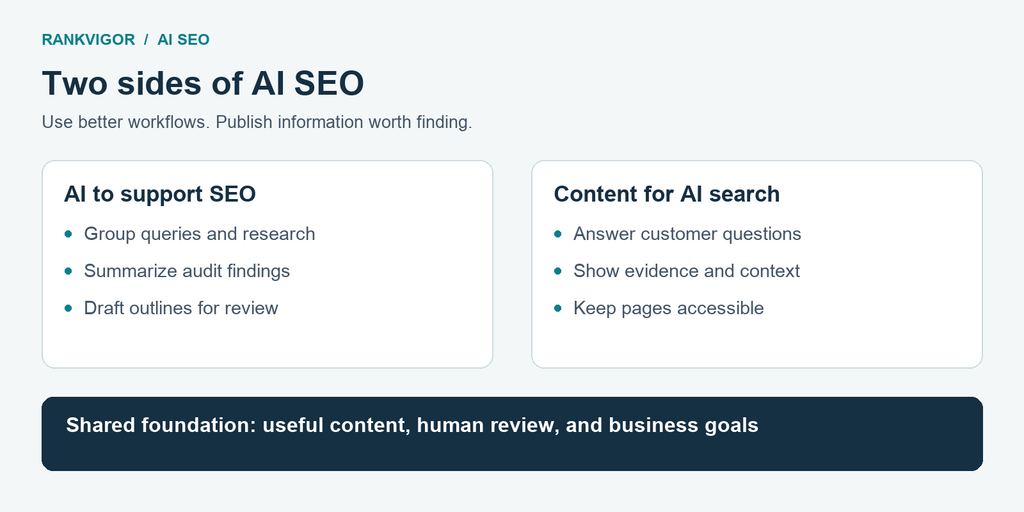
The first side is using AI to support your SEO workflow. Tools can help group related search queries, identify possible content gaps, summarize audit findings, and prepare outlines. The value is in saving time for decisions that need your experience and judgment.
The second side is improving your content for AI-powered discovery. That means answering useful questions, providing evidence, and maintaining a website that search systems can access. A clear explanation helps readers and makes your meaning less ambiguous.
You do not need to automate your workflow to earn search visibility. Choose tools when they solve a real problem, and have a person check their output. Google’s guidance on generative AI content warns that generating many pages without adding value can violate its scaled content abuse policy. AI assistance is a production choice, not a substitute for expertise.
How AI SEO relates to traditional SEO
Traditional SEO already involves relevant content, technical accessibility, useful links, and a good visitor experience. It is not about hitting a keyword-density target. Google’s SEO Starter Guide remains a useful starting point.
AI search adds another place where your business can be discovered: a generated answer may reference your page or mention your brand. That introduces extra measurement questions, but it does not remove the need to help people on your website.
For example, a roofing company can publish a useful guide to repair versus replacement. That page should answer the homeowner’s question, explain what depends on an inspection, and make it easy to request help. Those goals remain useful whether the visitor arrives through a search result or an AI answer.
What GEO and AEO mean
Generative engine optimization, or GEO, commonly describes work aimed at visibility in AI-generated responses. Answer engine optimization, or AEO, commonly describes work aimed at answering questions across search and answer experiences. The terms overlap, and their use varies across the industry.
Google’s generative AI optimization guide discusses both terms and treats optimization for its AI search experiences as SEO. Neither label describes a separate Google certification or a guaranteed route to citations.
Use clear headings that describe what follows. Questions work well when they match what your reader wants to know, but every heading does not have to be a question, and you do not need to force exact-match queries into your copy.
How AI search finds and references content
There is no single source-selection process shared by every AI platform. Google explains that AI Overviews and AI Mode may issue related searches through a technique called query fan-out. Different models and techniques can produce different supporting links. See its AI features documentation.
I have always believed that useful search content starts with understanding how someone investigates a topic. Give the direct answer, explain the context, and show the evidence behind it. That is a practical editorial approach, not a way to control an AI system’s decisions.
The often-quoted “up to 40%” improvement comes from the GEO research paper accepted at KDD 2024. The researchers reported improvements in their experimental visibility measures, with results varying by domain. This was not a promise of 40% more traffic or a guaranteed lift in today’s Google AI Overviews.
Add a statistic when it helps someone understand the answer. Cite the original source, include its date and scope, and leave it out if it does not support the point.
Practical steps for better AI search visibility
Start with pages your customers actually need
List the questions prospects ask before they contact you: what a service includes, what affects its cost, where you operate, and how to compare options. Choose a few important pages to improve before creating more content.
For a local service business, useful detail might include an explanation of the job, the limits of an online estimate, and what happens after an enquiry. Avoid publishing near-identical pages for every wording of the same question.
Check that search systems can access your content
Review the priority page in Search Console. Check indexing, the selected canonical URL, accidental noindex instructions, and crawl restrictions. Also check whether security or hosting rules block legitimate crawlers. Google says a page must be indexed and eligible for a snippet to appear as a supporting link in its AI features.
Check the Search generative AI control in Search Console under Settings. Google documents inclusion as the default, with child properties potentially inheriting a parent’s choice. An exclusion can prevent participation in the covered AI features. This setting is distinct from AI training controls.
Treat other platforms separately: check their current crawler documentation and your publishing preferences before changing access rules. Allowing a crawler does not guarantee a citation. If you are troubleshooting basic visibility, start with our guide to why your business is not showing up on Google.
Make the answer useful and easy to follow
Open each section with the point the reader needs, then add the explanation. Use a short list for steps and a table when someone needs to compare the same features across options. Keep essential information in page text instead of putting it only inside an image.
Here is an illustrative improvement for a roofing page. Replace “We offer the best roofing solutions” with “Our roof inspection checks the covering, flashing, drainage, and visible signs of leaks. We explain whether a repair is suitable or whether a replacement needs further assessment.” Publish details like these only when they accurately describe your service.
Show evidence from your work
Add relevant project photos, first-hand observations, clearly scoped results, or an explanation from the person who does the work. Identify the author or reviewer and give readers a way to understand their relevant experience. Do not invent credentials or claim that an author bio alone improves rankings.
For example, our GamingNewsLab case study reports 8.2K Bing clicks over the displayed 30-day period. That is a search-traffic result from our own site. It does not establish that AI citations caused the traffic or that another business will get the same outcome.
Connect related information and keep it accurate
Link a guide to the relevant service page, and link supporting articles where they answer a natural follow-up question. Use descriptive link text so readers know where they are going.
Keep business details, service availability, and customer-facing information accurate across your website and profiles. Review your local presence alongside the article; our local SEO checklist provides a starting point.
Use structured data for its intended purpose
Use appropriate structured data that matches the visible page. Do not add markup for services, reviews, or qualifications you cannot substantiate. Google does not require a special AI schema or an llms.txt file for AI search visibility.
Keep an FAQ section when it answers genuine reader questions. Google’s documentation updates state that FAQ rich results stopped appearing on May 7, 2026. FAQ markup should therefore not be sold as a way to obtain that Google result format or secure an AI citation.
How to measure AI SEO results
Track visibility, visits, and business outcomes separately. A citation shows that your content appeared in a particular answer. It does not tell you whether someone noticed your brand, visited your website, or became a customer.
Google now documents a Generative AI performance report in Search Console. It reports impressions for AI Overviews and AI Mode, with views by page, country, date, and device. The documentation says the insights rolled out worldwide by August 31, 2026, although insufficient impressions can mean a report is not visible. Use the report for its stated metric: impressions, not a complete picture of AI-driven revenue.
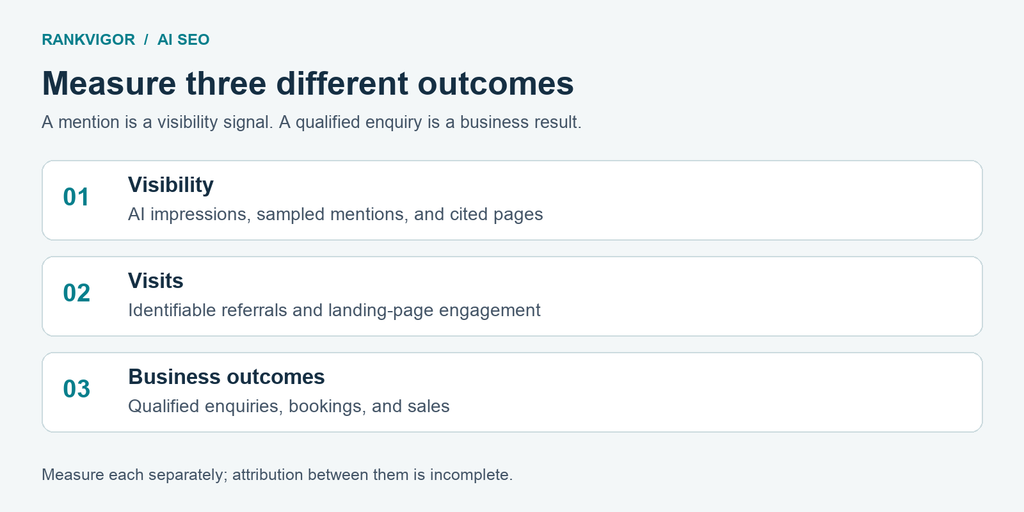
For other AI experiences, keep a repeatable sample of customer questions. Record the platform, date, location or language context, exact prompt, cited URL, and whether your business was mentioned. Save the response as evidence. Repeat the same sample over time, while recognizing that answers can vary between runs.
In analytics, examine identifiable AI referrals, landing pages, and completed enquiries or bookings. Some visits will not carry a useful referrer, so this is only part of the picture. Compare these results with organic search traffic and lead quality.
Branded searches can be a useful supporting trend, but they cannot prove that an AI mention caused the change. A practical reporting routine is to review visibility monthly, investigate meaningful changes, and judge investment against qualified leads and sales.
Common myths and limitations
AI SEO replaces SEO. The fundamentals still matter. A useful page also needs to be accessible and connected to the rest of your website.
A statistic or backlink guarantees a citation. No single edit can promise inclusion. Use evidence and earn relevant links because they serve a real purpose.
Long content always wins. Cover the question adequately. Length alone does not establish usefulness or expertise.
Every mention creates demand. Some answers lead to no website visit. Track what you can observe instead of assuming that every mention creates brand recall.
Results arrive on a fixed schedule. There is no reliable universal timeline for AI citations. Discovery, competition, the query, and platform changes all affect what you see.
Frequently asked questions
Can a small business benefit from AI SEO?
Yes. Start with clear service information and useful answers to the questions your customers ask. Focus on your real area of expertise and measure enquiries, not just mentions. A small business does not need a large publishing operation to make its existing pages more useful.
Can anyone guarantee a Google AI Overview citation?
No. Meeting eligibility requirements does not guarantee selection. Address technical issues and improve the usefulness of your content, then monitor what happens rather than buying a promised placement.
Do I need AI tools to do AI SEO?
No. Tools can help with research organization and routine analysis, but human-written, carefully reviewed content can also serve readers well. Use automation where you can check its accuracy and where it saves worthwhile effort.
Do I need FAQ schema or llms.txt?
Neither is a special requirement for Google’s AI search features. Keep FAQs for readers, and follow each platform’s current documentation before adopting additional files or markup.
How long should I wait before judging results?
Set a baseline before editing and review progress at a regular interval, such as monthly. Confirm that changed pages can be discovered, then assess visibility and qualified leads over multiple reporting periods. Avoid treating a six- or twelve-month citation promise as an established rule.
Start with your most important pages
You do not need to rebuild your entire website to begin. Pick the pages closest to a customer decision, resolve access issues, improve the answers, and add evidence from your work. Measure the result and use it to choose the next improvement.
Want a second pair of eyes? Get a free 5-minute video audit from RankVigor. We will walk through your rankings and the fixes that matter, delivered in 48 hours with no sales call required. Start with a clearer view of what your website needs.