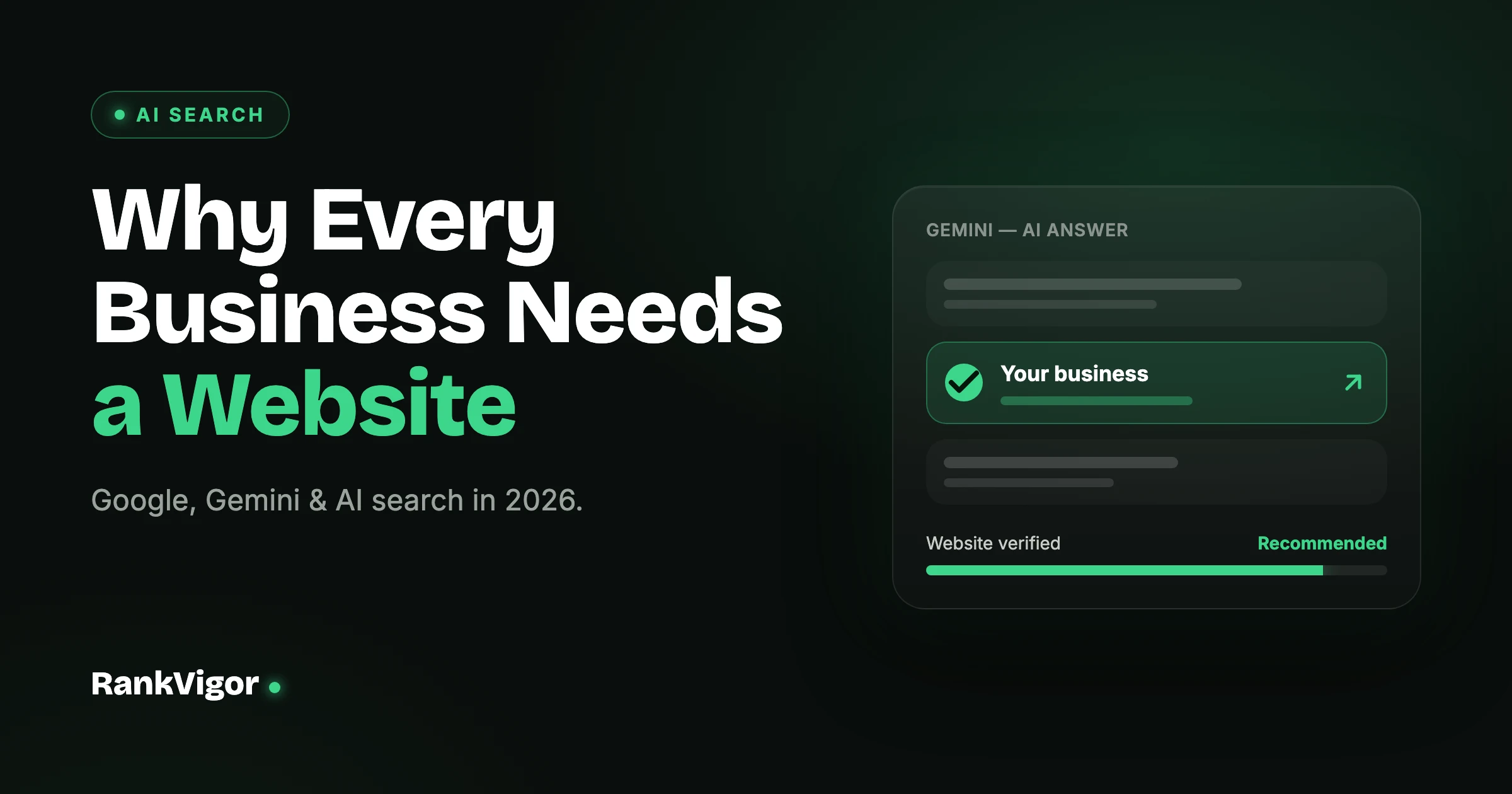
In 2026, AI search engines like Gemini and ChatGPT recommend businesses based on structured, authoritative web content. If you do not have a website, you are invisible to these systems. If you have no site, you are not just missing Google rankings. You are missing AI recommendations entirely.
We are going through this change right now. AI works like a private investigator. It looks for proof that your business is real, trustworthy, and worth recommending. If you don’t have a website, you give that opportunity to your competitor who does.
Why Does Google Gemini Need a Website to Recommend My Business?
Google Gemini and other AI engines make sure your business is real, trustworthy, and worth recommending before suggesting it to users. To do this, they scan the structured content on your website. A website gives these systems raw HTML to crawl, entity information to verify your business, and trusted pages to use as references. Without a website, AI has no main source it can rely on.
According to SearchLab, 76% of people who search on mobile for local businesses visit one within 24 hours. AI engines know this. They want to send users to businesses they can verify.
Your website is that proof. It includes your services, contact details, credentials, and customer proof. A Google Business Profile is like a signpost, while your website is the real destination.
When AI creates an answer, it gets information from the open web. It checks multiple sources. If your competitor has clear service pages on their website and you only have a social media page, AI is more likely to mention them. Not because they are better, but because their information is easier to verify.
What Happens When Patients in Darbhanga Ask AI for a Doctor?
AI recommends the doctors who have complete online proof: a website, updated hours, a phone number, and a fully optimized Google Business Profile. The ones missing these details get filtered out before the user ever sees a name.
I have seen this firsthand in Darbhanga. Most doctors there have not even added working hours to their Google Business Profile. Patients do not know when they are available.
This matters because 87% of consumers read reviews before choosing a local business. Many use a free subdomain from another service just for booking. That is not enough.
When someone asks Gemini for the best general physician, the AI looks for structured data. It wants to see a real domain, not a rented subdomain. It wants to see a phone number, a WhatsApp number, and complete business details. If you optimize your Google Business Profile and link it to a real website, your chances of being recommended jump dramatically.
This is not theory. This is exactly what we fix. We build websites for local businesses and we see the difference when AI starts recommending them.
Is a Google Business Profile Enough Without a Website?
No. A Google Business Profile helps, but it cannot host detailed service pages, patient testimonials, or booking systems that AI engines need to build a full recommendation. It is a directory listing, not a proof engine.
A complete GBP gets 7 times more clicks than an incomplete one. But here is the catch: 44% of businesses never fully optimize their profile. They leave out hours, services, and photos. Worse, they do not link a website.
AI engines use your GBP as a starting point. Then they look for your website to confirm what you do. If there is no site, the trail ends. You might show up on Maps, but you will not get the rich recommendation in Gemini or ChatGPT.
You need both. Rank higher on Google Maps with a complete profile, but own your content on your own domain.
Why Social Media Alone Cannot Replace a Website in 2026
Social media is like rented land. You don’t own your followers. You don’t control your reach either. And AI engines can’t scrape your Instagram bio the same way they crawl a website for structured data.
Network Solutions reports that 21% of businesses without a website say they prefer social media instead. That is a gamble. Algorithms change overnight.
A Facebook page that reached 1,000 people last month might reach only 50 people today. Your website doesn’t depend on a platform’s changing algorithm or decisions.
More importantly, AI search engines need content they can index and cite. They read raw HTML. They extract schema markup.
AI crawlers need content in raw HTML they can index, not posts trapped inside a social app. If your entire online presence lives inside a social app, you are invisible to the systems that now drive the most valuable traffic.
How Does a Website Build the Trust Signals AI Engines Look For?
A website provides clear information about your company, topical authority, and content that AI engines can use as a trusted reference before recommending your business. AI engines need clear information, structured data, and topical authority to trust a business. Structured data and clear service pages help AI understand who you are, what you do, and why your business matters.
According to Semrush, 50% of ChatGPT citations point to business and service websites. This is not a coincidence. AI engines are trained to trust domains with clear entity signals. They look for LocalBusiness schema, FAQ pages, and trusted content.
When we implemented this for a roofing client in Mississippi, we saw their site cited across AI Overviews, Grok, and Perplexity. We built clear service pages. We added schema markup. We made sure AI crawlers could read the raw HTML without fighting through heavy JavaScript.
The result: 59 citations across AI platforms and a jump to 3.1K monthly organic visitors. If you are wondering why your website is not ranking on Google, the answer often starts with missing trust signals. AI needs proof. Your website is where you build it.
What Should My Business Website Include to Rank in AI Search?
You do not need a 50-page site. You need the right pages. Start with a clear homepage that says who you are, where you serve, and what problem you solve.
Add dedicated service pages for each offer. Include a contact page with a real address, phone number, and a map.
Add testimonials or case studies. AI engines read these as social proof. Add an FAQ section with schema markup so AI can extract answers directly from your site. Make sure your site loads fast.
53% of mobile users leave pages that take longer than 3 seconds. And yes, make it mobile-first. Most local searches happen on phones.
Follow a local SEO checklist to make sure you cover every base. The businesses that win in AI search are the ones that make it easy for machines to understand them. They do not hide behind complex code or missing pages. They publish clear content, mark it up properly, and let AI do the rest.
Conclusion
AI search is not coming. It is here. Google Gemini, ChatGPT, and Perplexity are already recommending businesses to customers who ask.
AI-referred traffic converts at 14.2% compared to 2.8% from traditional search. That means the businesses AI recommends get not just more traffic, but better traffic.
If you need a website that AI can recommend, we can build it. If you need SEO that gets you found, we can do that too. Visit our services page to see how we work, or check our case studies for real client results.
Frequently Asked Questions
Do I need a website if I already have a Facebook page?
Yes. Facebook is useful, but AI search engines cannot crawl it the way they crawl a website. A website gives you owned content that AI can cite and recommend.
How long does it take for AI search engines to start recommending my business?
It depends on how fast you build authority. A new site can take 3 to 6 months to earn trust. An optimized site with clear content and backlinks gets noticed faster.
What is the most important page on my website for local SEO?
Your homepage and service pages matter most. They should include your location, your services, and clear contact details. Add LocalBusiness schema markup so AI understands your entity.
Can I just use a free subdomain from my appointment booking service?
No. A subdomain does not build your authority. AI engines trust real domains more. You need a website you own so you control the content, the branding, and the trust signals.
How much does a professional business website cost in 2026?
Costs vary, but a professional small business site typically ranges from $500 to $5,000 depending on features. The real cost is not having one and losing AI recommendations every day.