Building trust is the biggest challenge for any local business. Because of this, local business owners often think about how they can build trust in their local market so more customers contact them and choose their services.
Because of this, they often wonder whether trust matters more than marketing in SEO. If they are hiring an agency to do SEO for their website, what should they focus on first? Should their priority be trust or marketing? This complete blog post explains the answer in detail.
How Do I Get Better Google Reviews Without Sounding Pushy?
The best reviews come when you ask customers right after they are satisfied, send them a simple text message with a direct review link, and make the whole process as easy as possible for them.
For example, if your business is related to roofing and you have solved a customer’s roofing problem, that is the best time to ask for a review. Asking at the right time can be very beneficial for your business. Since you have successfully solved their problem, the review they write will naturally include the questions they had before and how your service solved them. When a client leaves a review at that moment, it is more relevant and authentic, which helps build trust in your business.
According to a report, 93% of customers decide whether to use a business based on its reviews. If your reviews are relevant, related to your services, and focused on the solutions you provide, the chances of attracting new clients increase significantly. This is the right approach because genuine reviews build the strongest trust for any local business.
For a deeper walkthrough, see our guide on how to optimize your Google Business Profile.
What Kind of Reviews Actually Build Trust and Generate Leads?
Reviews that mention specific services, locations, and outcomes convert up to 42% more than generic praise because they answer the exact questions future customers are asking.
When someone searches “roof repair near me,” they want to know three things: Do you do this exact service? Do you serve this exact area? And did you do it well for someone like me? A detailed review answers all three before they even call.
Before asking a client for a review, always remind them which problems you helped solve. This helps them remember what issues were fixed, so they can write a review based on their real experience. Instead of leaving a generic review like “Best service in this location,” they are more likely to write a real, detailed, and experience-based review.
The total number of reviews is less important than how recent they are. Google gives more value to fresh and genuine reviews that come in regularly than to a large number of old reviews. Instead of 50 reviews from six months ago, getting two new reviews every week is considered more effective. Fresh reviews tell Google that the service provider is consistently delivering good service and that the business is still active.
Reply to every review, good and bad. Thank happy customers by name. For negative reviews, respond calmly and publicly. A thoughtful reply to a one-star review often impresses future customers more than the complaint itself ever hurt you.
What Are the Basic Trust Signals Every Local Business Website Needs?
Every local business needs five core trust signals:
- Real customer reviews
- Clickable phone number in the header
- Actual team and project photos
- Consistent NAP everywhere
- Clear service descriptions written for humans
This is important because users decide whether to trust a website in just 50 milliseconds. According to a report, 81% of customers say that a brand must be trustworthy before they decide to buy its products or use its services.
Stock photos reduce trust because customers can easily recognize them. Instead, real photos of your team and completed projects show that you are the service provider the user is looking for. Also, your Name, Address, and Phone Number (NAP) should be exactly the same across every platform, including your website, Google Business Profile, Yelp, Facebook, Apple Maps, and Bing Places.
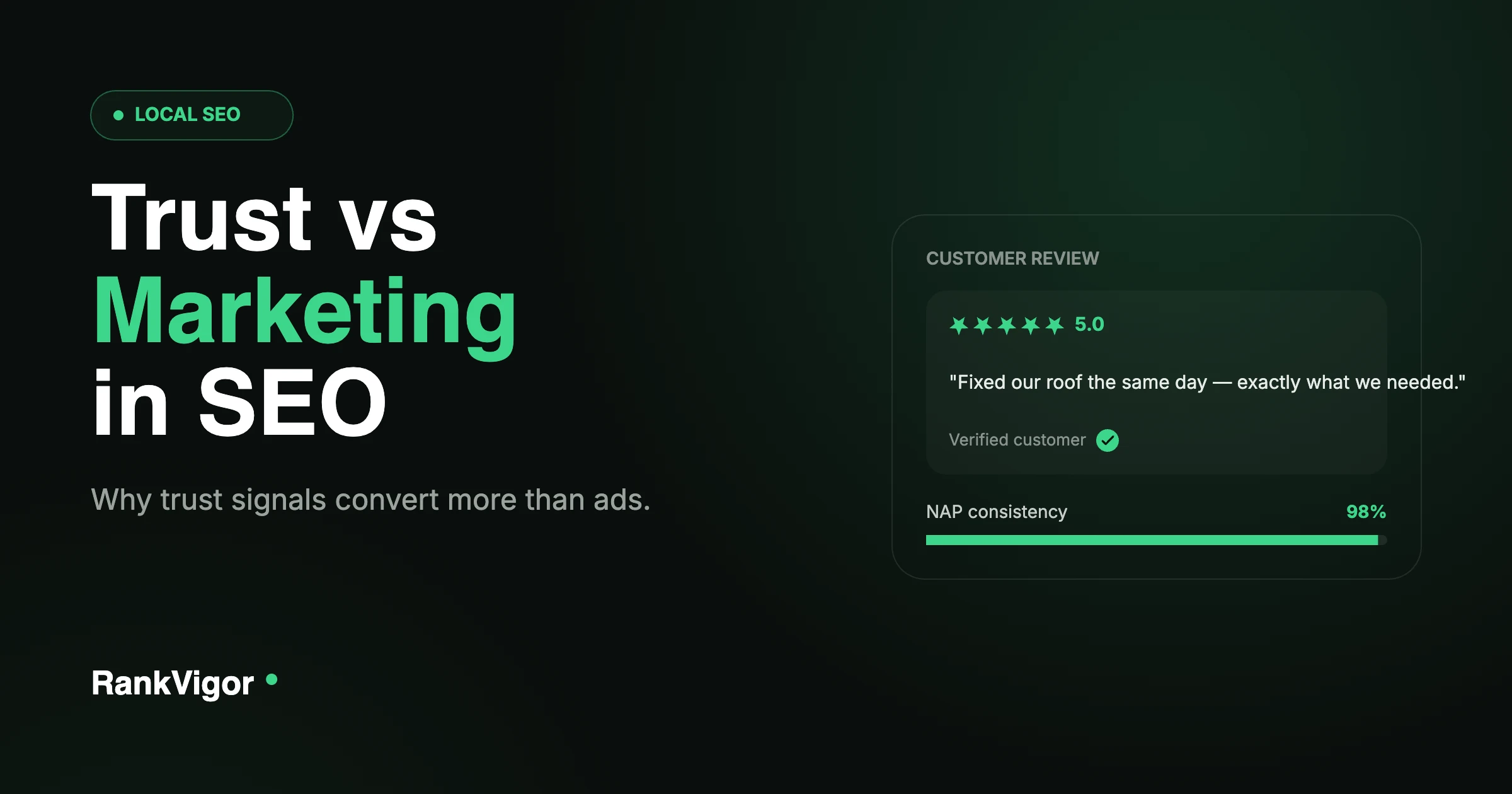
According to Poly Rocha, businesses with 95% or higher NAP consistency (Name, Address, and Phone Number) rank an average of 3.2 positions higher than businesses with mismatched information. Even small differences like “Rd” and “Road” can confuse Google, which can hurt both your business’s credibility and trust.
If your site isn’t ranking at all, start with our breakdown of why your website isn’t ranking on Google.
How Do I Improve My Business Trust So Customers Choose Me Over Competitors?
If you can prove that you are a real, trustworthy, and skilled service provider before a customer even calls you, they are much more likely to trust your business. To do this, your website should be up to date, include real photos of your team and completed work, have professional replies to every review, and show third-party recognition such as certifications or media mentions.
An outdated website can quietly reduce people’s trust. If your last blog post was published in 2019, visitors may start wondering if your business is still active. It gives the impression that the business is not being maintained regularly, which can have a negative impact on trust.
Case studies and “Before & After” photos have the biggest impact because they do not just make promises, they provide real proof of your work. When we documented the project timeline and results for Watkins Construction, those pages became some of the most visited pages on the website. People always want to see the kind of work you have done for customers with problems similar to theirs.
Transparency builds trust much faster than perfection. When you clearly explain your process, timeline, and pricing range, it removes a lot of uncertainty from the customer’s mind. People are more likely to contact honest and transparent businesses than businesses that look impressive but do not provide clear information.
Third-party validation matters too. Certifications, trade associations, local news features, and backlinks from reputable local sites all tell Google and customers that other trusted entities vouch for you. Our local SEO checklist walks through how to build these signals step by step.
Do I Need to Optimize My Business for AI Search and ChatGPT?
Yes. AI search engines like Perplexity, Google AI Overviews, and ChatGPT cite businesses that demonstrate clear expertise, structured answers, and strong E-E-A-T signals. For local businesses, this means optimizing your Google Business Profile, using schema markup, and building topical authority.
Traditional Google Search shows 10 blue links, while AI Search gives a combined answer using information from sources it trusts. In Google AI Overviews, 76% of citations come from pages that already rank in Google’s Top 10 search results. This means the standard for getting cited in AI Search is now much higher than before.
E-E-A-T stands for Experience, Expertise, Authoritativeness, and Trustworthiness. As Google’s Gary Illyes has explained, E-E-A-T is mainly strengthened by links and mentions from trusted websites. For any local business, this means having its name listed in trusted local directories, getting mentioned in local news, and maintaining a Google Business Profile that shows the business is real, active, and trustworthy.
Organize your content so AI can easily find answers in it. Use clear headings, bullet points, and an FAQ section. Pages updated within the last two months receive 28% more AI citations than older pages. Fresh and regularly updated content tells AI that your information is up to date and trustworthy.
You do not need to become an AI expert. Just do the basics better than your competitors. Keep your business information accurate and up to date, answer your customers’ real questions clearly on your website, and present those answers in a clean and organized way. Our Local SEO Services package also includes AI Search Optimization.
Final Word
Trust is not built through one big campaign. It grows through dozens of small details that customers notice without even thinking about them. The most successful businesses are not the ones with the biggest ad budgets. They are the ones whose website, profile, and reviews make customers feel that “These people are real, and they know exactly what they’re doing.”
If you want a second pair of eyes on your local SEO, get a free 5-minute video audit from RankVigor. We’ll show you exactly where your trust signals are strong and where they’re costing you leads. No sales call. Just real answers.
Frequently Asked Questions
How many reviews does a local business need to look trustworthy?
Most consumers expect at least 10 to 20 recent reviews. What matters more than total count is the pattern: a steady flow of fresh, detailed reviews with responses from the owner. A business with 15 recent, specific reviews often looks more trustworthy than one with 100 old, generic ones.
Should I respond to negative reviews, or just ignore them?
Always respond publicly and calmly. A thoughtful reply shows future customers that you care about fixing problems. A professional response to criticism often impresses readers more than the complaint itself ever hurt you. It turns a negative into proof that you’re a real business run by real humans.
Can I use stock photos on my website and still build trust?
You can, but real photos work much better. Customers spot stock images and subconsciously lower their trust. Actual photos of your team and finished projects prove you exist. If you must use stock photos, mix them with genuine images and make sure the real ones are prominent.