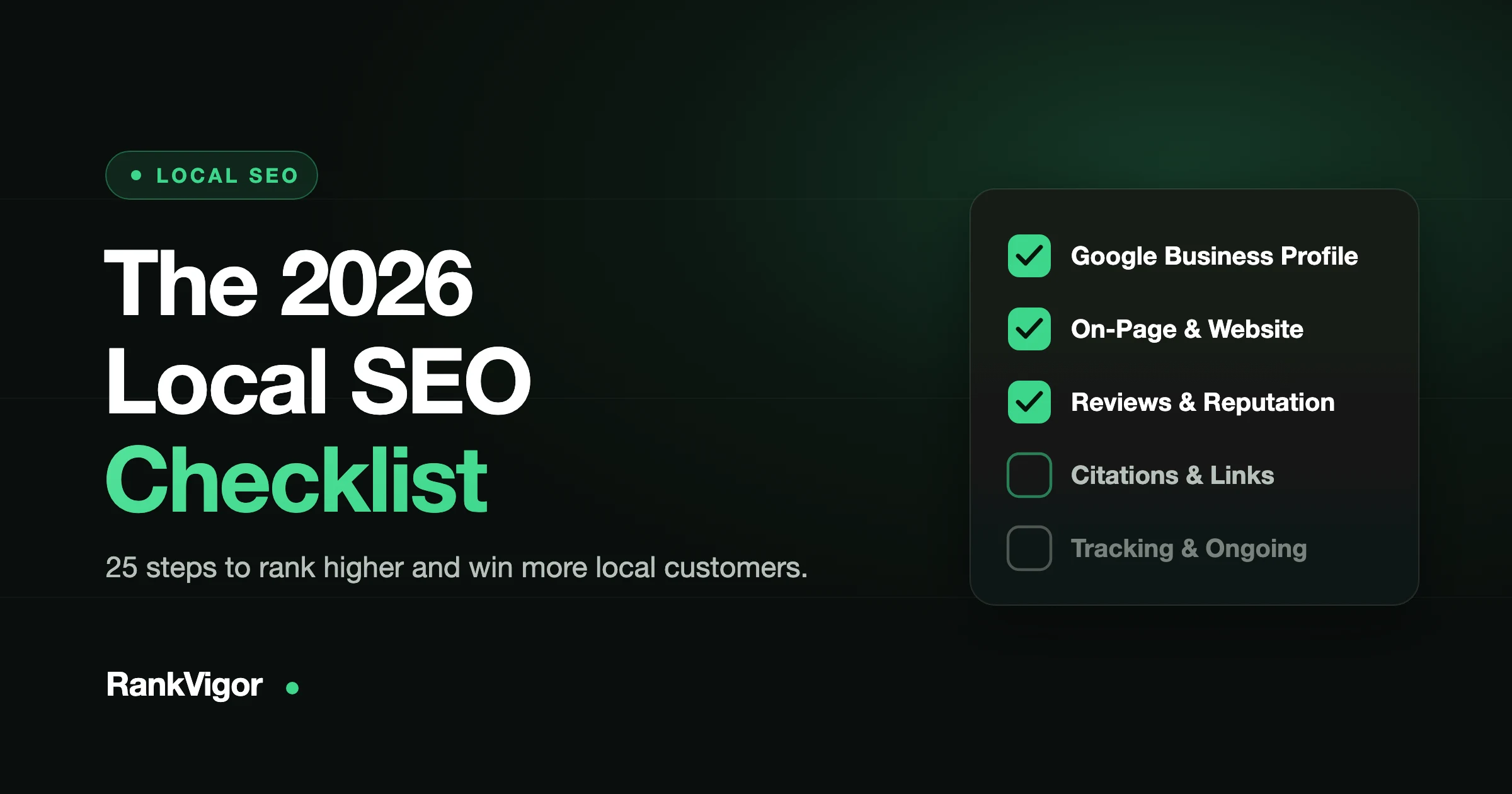
If you run a local business, ranking in your own town shouldn’t be guesswork. Local SEO comes down to a finite set of signals — and most of them you can fix yourself in an afternoon. This checklist walks through every one, grouped by where it lives: your Google Business Profile, your website, your reviews, and your citations.
It matters because local intent is huge. Google has reported that 46% of all searches have local intent, and that 76% of people who search for something nearby on their phone visit a business within a day. When you’re not in those results, a competitor is.
Work through the sections in order. The Profile checklist is the foundation — get it right before you touch anything else.
Bright Smile Dental
4.9 · 127 reviews
Dentist · Open now · 0.4 mi
124 Main St, Austin, TX 78701
(512) 555-0148
Google Business Profile Checklist
Your Google Business Profile (GBP) is the single biggest local ranking factor — it’s what feeds Google Maps and the local “map pack” that sits above the regular results. A complete, verified, actively maintained profile is worth more than almost anything you do on your website. Start here.
- Create and claim your profile. Google Maps shows results from Business Profiles, not from your website alone. If you’ve never set one up — or someone created an unclaimed listing — Google has nothing verified to show.
- Complete verification. Until Google confirms you own the business (by postcard, phone, or video), your listing often won’t appear at all.
- Choose the most specific primary category. Your primary category is one of the strongest signals. A dentist picks “Dentist”, not “Healthcare”. Add relevant secondary categories too.
- Fill in every field. Name, address, phone, website, hours, business description, and attributes — leave nothing blank. Completeness is a ranking signal in itself.
- Keep your name, address, and phone (NAP) exact. Use your real-world business name, not a keyword-stuffed version.
- Add at least 10 quality photos. Businesses with photos get 42% more direction requests and 35% more website clicks than those without.
- Post weekly updates. Offers, news, and events published to your profile keep it active — most competitors ignore this entirely, so it’s an easy edge.
- Seed the Q&A section. Anyone can ask (and answer) a question on your profile, including people who get it wrong. Add your own FAQs with accurate answers before someone else fills the gap.
If your business isn’t appearing on Maps at all, work through our guide to why a business doesn’t show up on Google Maps first, then come back here.
<h1> Best Austin Dentist — Bright Smile
<h2> Dental services in Austin
<h2> Visit our Austin office
LocalBusiness schema
On-Page & Website Local SEO Checklist
Your website backs up your Business Profile and helps Google trust that your business is genuinely tied to your location. The goal is to make your location and services unmistakable — in your page titles, your headings, your content, and your structured data. These steps reinforce every signal your GBP is already sending.
- Put your city in key places. Work your location naturally into title tags, H1s, and body copy — not stuffed, just present where it makes sense.
- Build a dedicated location page for each area you serve. One thin page listing 20 suburbs won’t rank; a real page per core location will.
- Add LocalBusiness schema markup. This structured data hands Google your name, address, phone, and hours in a format it reads with zero ambiguity.
- Create service pages for what you actually do. A page per service (with local context) gives Google and customers a clear answer to “do they do this, near me?”
- Make sure the site is fast and mobile-friendly. Most local searches happen on phones. A slow or clunky mobile site costs you rankings and customers — see our technical SEO service if speed is the bottleneck.
- Confirm Google can actually index your pages. A page that isn’t indexed can’t rank. If pages are missing from search, our guide on why a website isn’t ranking on Google covers the usual culprits.
- Show your NAP on the site. Put it in the footer and on a contact page, formatted exactly as it appears on your Business Profile.
4.9 ★ · 127 reviews · +3 this week
Sarah M.
“Best dentist in Austin — booked online and barely waited. The whole team was great.”
Owner reply · Thanks Sarah! See you at your next visit.
Reviews & Reputation Checklist
Reviews influence both your ranking and whether searchers actually choose you. According to BrightLocal’s annual local consumer survey, the overwhelming majority of people read online reviews before using a local business. Google rewards a steady stream of recent, genuine reviews — quantity, rating, and recency all count — so treat review generation as an ongoing habit, not a one-time push.
- Ask every happy customer for a review. A simple, direct ask at the right moment is the highest-leverage thing you can do. Send the link by text or email.
- Aim for consistency over volume. Two or three new reviews a week looks healthier to Google than 50 reviews a year ago and silence since.
- Reply to every review — good and bad. Responses signal an active, trustworthy business and give you a chance to add keywords and context naturally.
- Handle negative reviews calmly and publicly. A measured, helpful reply to criticism often impresses future customers more than a wall of five stars.
- Never buy fake reviews. It violates Google’s policies, risks your listing, and savvy customers spot them instantly.
Citations & Local Links Checklist
A citation is any online mention of your business name, address, and phone number — and consistency across all of them tells Google your business is real and established. Beyond citations, local backlinks from genuinely relevant sites push your authority higher. This is where steady, unglamorous work separates you from competitors who stopped at their Business Profile.
- Fix NAP consistency everywhere. “Rd” on one directory and “Road” on another can confuse Google. Make every mention identical.
- Claim the core directories. Get listed accurately on the major local and industry directories your customers and Google trust.
- Find industry-specific listings. Trade associations, chambers of commerce, and niche directories carry more weight than generic ones.
- Earn local backlinks. Sponsor a local event, partner with nearby businesses, or get covered by local press — relevant local links are a strong authority signal. Our link building service can help if this is slow going.
- Audit and remove duplicate listings. Two profiles for one business split your signals and confuse customers. Merge or remove duplicates.
Map-pack rank · “austin dentist”
Tracking & Ongoing Checklist
Local SEO is never “done” — Google updates, competitors move, and your profile needs feeding. The businesses that win are the ones that treat this list as a monthly habit rather than a one-off project. Set up tracking so you can see what’s working, then keep the highest-impact tasks on a recurring schedule.
- Track your map pack rankings for core terms. Watch where you sit for your most important “service + city” searches over time.
- Monitor GBP insights. Calls, direction requests, and profile views tell you whether your optimization is translating into action.
- Review your search traffic monthly. Connect Google Search Console and check which local queries actually bring people in.
- Keep posting and gathering reviews. These two habits, done weekly, compound more than any single optimization.
- Re-audit quarterly. Run back through this checklist every few months to catch new gaps and undo competitors’ gains.
This week
This month
Keep doing
What to Prioritize First
If you can’t do everything at once, here’s the order that delivers the fastest movement:
Do this week: Claim and fully complete your Google Business Profile, set the right primary category, and ask your last 10 happy customers for reviews.
Do this month: Fix NAP consistency across the web, build location and service pages, and add LocalBusiness schema.
Keep doing forever: Post weekly, gather reviews steadily, reply to every one, and re-audit each quarter.
Most local businesses see real movement within one to three months of consistent effort. For a deeper dive on climbing the rankings once you’re visible, read our complete guide to improving your Google Maps ranking.
Want a second pair of eyes? Our local SEO team will tell you exactly where the gaps are.
Frequently Asked Questions
What is local SEO?
Local SEO is making your business visible for searches with local intent — the map pack, Google Maps, and “near me” results. It combines your Google Business Profile, your website’s location signals, reviews, and citations across directories.
How long does local SEO take to show results?
Most local businesses see real movement within one to three months of consistent effort. The fastest wins come from completing your Google Business Profile, setting the right primary category, and asking recent customers for reviews.
What matters most in local SEO?
In order of impact: a fully complete Google Business Profile with the correct primary category, a steady flow of genuine reviews you reply to, consistent NAP everywhere, then location pages and LocalBusiness schema on your website.
How often should I update my local SEO?
Treat it as ongoing: post weekly, gather and reply to reviews continuously, and re-audit the full checklist each quarter. Profiles that stay active consistently outrank ones that were optimized once and forgotten.