Thousands of websites cover the same topic now, and all of them claim to be helpful. Google and AI engines like ChatGPT, Perplexity, and Google AI Overviews have to decide in a split second which pages rank and which ones get cited in AI answers. They don’t guess. They use specific, measurable signals.
Until your rankings are affected, you probably don’t think much about the difference between thin content and helpful content. This post explains how that decision is made. It covers what makes content thin, what makes it helpful, why authority sites get more flexibility, and what you can do about it. No theory, just a simple explanation of how the system thinks.
What Is Thin Content
Thin content is content created mainly to attract search traffic while adding little or no real value for the reader. Helpful content is made for people first: it answers their question completely, draws on real experience, and leaves them with no need to search again.
Google’s own documentation explains it in simple words: create content for people, not just for search engines. It also shows how to review your own content. Does the page include original information or analysis? Does the headline avoid exaggerated claims? Will readers feel they actually learned something new?
It also explains the “who, how, and why” test. Who created the content? Is there a real author with a clear identity? How was it created? Does it include personal experience or original research? Why was it created? Was it made to help people, or just to rank in search results?
Fail those questions and your page lands in the thin bucket. Thin content is one of the most common reasons a website doesn’t rank on Google, especially for newer sites with no authority cushion.
How Does Google Decide If Your Content Is Thin or Helpful?
Google decides content quality through signals like E-E-A-T (experience, expertise, authoritativeness, trust), originality, and reader satisfaction. It also scores your whole site: enough unhelpful pages can drag down the rankings of your good ones.
E-E-A-T may sound technical, but it’s really based on four simple questions. Have you actually done what you’re writing about? Do you have deep knowledge of the topic? Do other people see you as a trusted source? Is the information you provide accurate? As Marie Haynes explains, Google’s systems now give more importance to content that truly meets the searcher’s needs, instead of content that only looks well-optimized on the surface.
Google’s March 2024 Core Update integrated the Helpful Content System into its core ranking systems. According to Google, the update reduced low-quality and unoriginal content in search results by 45%.
Another thing that most site owners overlook is that this decision is partly based on the overall quality of the entire website. The Helpful Content System evaluates a site as a whole. This means that having too many weak pages can also hurt the rankings of your strongest pages.
How Do AI Engines Choose Which Website to Trust?
AI answers are not generated from a single source. They are built using information from multiple sources at the same time. AI engines break a question into several smaller sub-questions, then select the pages that perform well for each of them. They also give priority to brands that are mentioned widely across the web.
This is what actually happens behind the scenes: when you ask an AI engine a question, it breaks the question down into several related smaller queries and collects relevant pages for each one.
Ahrefs analyzed millions of AI Overview citations and found only about 38% of cited URLs also rank in the organic top 10. The rest rank for the fan-out queries, not the main one.
AI engines also cross-check. Pew Research found that 88% of AI summaries cite three or more sources, with Wikipedia, YouTube, and Reddit among the most cited. When many trusted sources agree, the AI treats the information as reliable.
How Does a Site Become Trustworthy?
Ahrefs studied 75,000 brands and found that brand mentions across the web are much more closely linked to AI visibility than traditional authority metrics like Domain Rating. In simple words, AI is more likely to trust brands that are consistently talked about across the web.
I’ve been working in SEO since 2015. Since Google introduced AI Overviews, I’ve seen this happen firsthand. The content we created for a roofing client was cited 59 times by AI Overview, Grok, and Perplexity. That didn’t happen because the domain was very large. It happened because the client’s service solved real problems and answered the questions people were actually asking. That’s one of the biggest reasons every business needs a website in 2026. AI engines pull answers from websites they already trust.
Why Big Sites Get Away With Thin Content
Now let’s talk about the part that frustrates almost everyone. Authority works like a shortcut to trust. A high-authority domain can rank even with a basic or slightly rewritten page, while the original creator on a smaller website may end up being treated as the one who copied the content.
This is not a conspiracy theory. Google has an entire spam policy for it. Site Reputation Abuse targets websites that mainly host third-party content to take advantage of the host site’s ranking signals. The policy was introduced because many large publishers had been doing exactly this for years. For example, major news websites added coupon portals and product review sections to their sites. Forbes Advisor, CNN Underscored, and WSJ Buy Side were all cited as examples of this model.
Enforcement has also become much smarter than before. Glenn Gabe found that when site-wide signals were removed from certain sections of highly trusted websites, their rankings dropped sharply. This happened because of Google’s system that checks whether a section is completely separate from the rest of the website.
But let’s be honest about the bias. Analysis of the Helpful Content Update showed that the brands that performed better had stronger brand authority. Ahrefs also found that brands in the top quartile receive 10 times more AI mentions, while 26% of brands don’t get a single mention. Brand authority is a real ranking factor. It may not seem completely fair, but that’s the reality.
We run 3 blog websites ourselves, so we understand both sides. Our smaller sites have to prove themselves twice as much. Complaining about this bias doesn’t help. The real solution is to build signals that remove doubt. That’s exactly how we helped a roofing client go from having almost no online presence to reaching 3.1K monthly visitors through genuine, hard-earned authority.
Thin Content vs Helpful Content: The Side-by-Side Check
Sometimes the fastest way to judge your own page is a direct comparison. Here’s the check we run on client content:
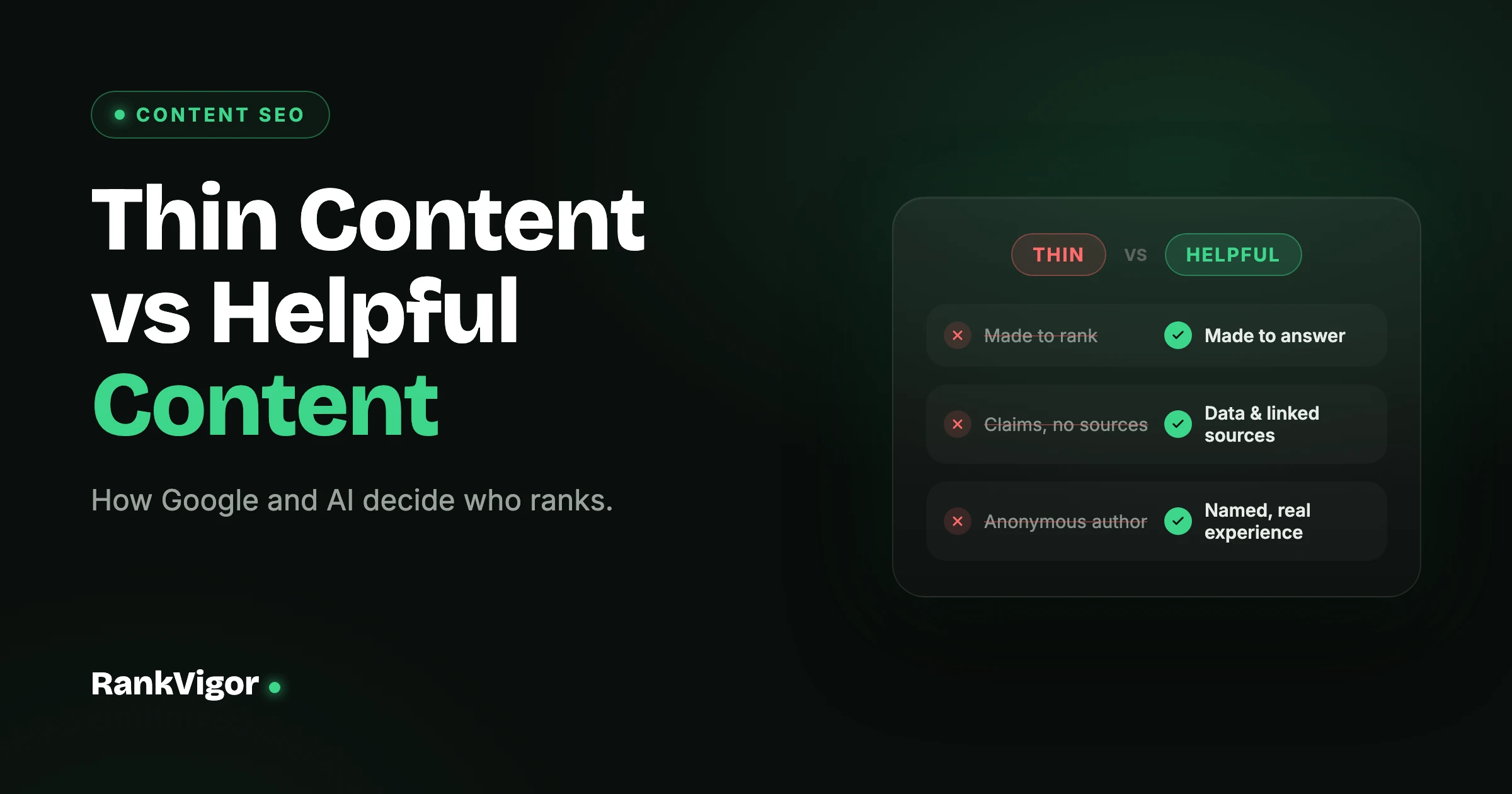
| Signal | Thin Content | Helpful Content |
|---|---|---|
| Purpose | Made to rank | Made to answer |
| Depth | Skims the topic | Fully covers the question |
| Originality | Rewrites what already exists | Adds something new |
| Evidence | Claims without sources | Data and linked sources |
| Author | Anonymous or generic | Named, with real experience |
| Reader leaves | Needing another search | Satisfied |
Now audit your own site. Open your five weakest pages and review each one using Google’s self-assessment questions mentioned earlier. Be completely honest with yourself. If a page doesn’t offer anything beyond what is already available on ten other pages, it’s thin content, and Google is likely to see it the same way.
How Do You Make Content Helpful Enough to Beat the Big Sites?
Only publish content that you can uniquely provide, such as original data, real examples, and personal experience. Make it clear who is behind the content. Instead of covering many topics with surface-level information, focus on one topic and go deep. Also, earn brand mentions and quality links so AI engines can recognize you as a trusted and well-known source.
Concretely, here’s the playbook we use:
- Add what competitors can’t copy. Client numbers, real screenshots, before-and-after data. Our content SEO case study ranks because it’s built on results nobody else has.
- Put a name and a track record behind the content. Anonymous content reads as thin to both Google and AI engines.
- Own one topic completely. Ten deep, interlinked pages on one subject beat fifty shallow pages on ten subjects.
- Earn mentions and links. Brand mentions drive AI visibility, and earned links that build authority still move Google rankings. Both compound.
- Write around real questions. That’s the core of good content SEO: answer what customers actually type, better than anyone else.
None of this is fast. All of it compounds.
Conclusion
The difference between thin content and helpful content is not based on guesswork. It depends on a few clear signals: originality, experience, user satisfaction, and brand authority. Yes, it’s true that larger domains often have an advantage.
Publish content that only you can create, then build the right brand signals so machines learn to trust it. Want to know whether Google sees your pages as thin or helpful?
Frequently Asked Questions
Can thin content still rank on Google?
Yes. Pages on high-authority domains often rank with thin content because Google treats domain trust as a shortcut. The gap is narrowing, though: site reputation abuse enforcement now targets third-party content hosted mainly to exploit that trust.
Does word count decide whether content is thin or helpful?
No. A 300-word page that fully answers the question is helpful, and a 3,000-word page padded with fluff can still be thin. Google’s people-first content guidance never mentions length. It asks whether the content is complete and satisfying.
Is AI-generated content automatically thin content?
No. Google’s scaled content abuse policy targets mass-produced, unoriginal pages, regardless of how they were made. AI-assisted content with original data, real expertise, and human oversight can qualify as helpful.
How do I check if my website has thin content?
Start with Google Search Console and find pages with zero impressions or clicks. Then run each one through the self-assessment questions from the first section: does it add original value, and would a reader leave satisfied? Pages that fail both are your thin content.
How long does it take to recover after Google flags unhelpful content?
Expect months, not weeks. Helpful content evaluation now runs inside Google’s core ranking systems, which reassess sites continuously. Fix or remove the weak pages across your whole site, then give recrawling time to work.