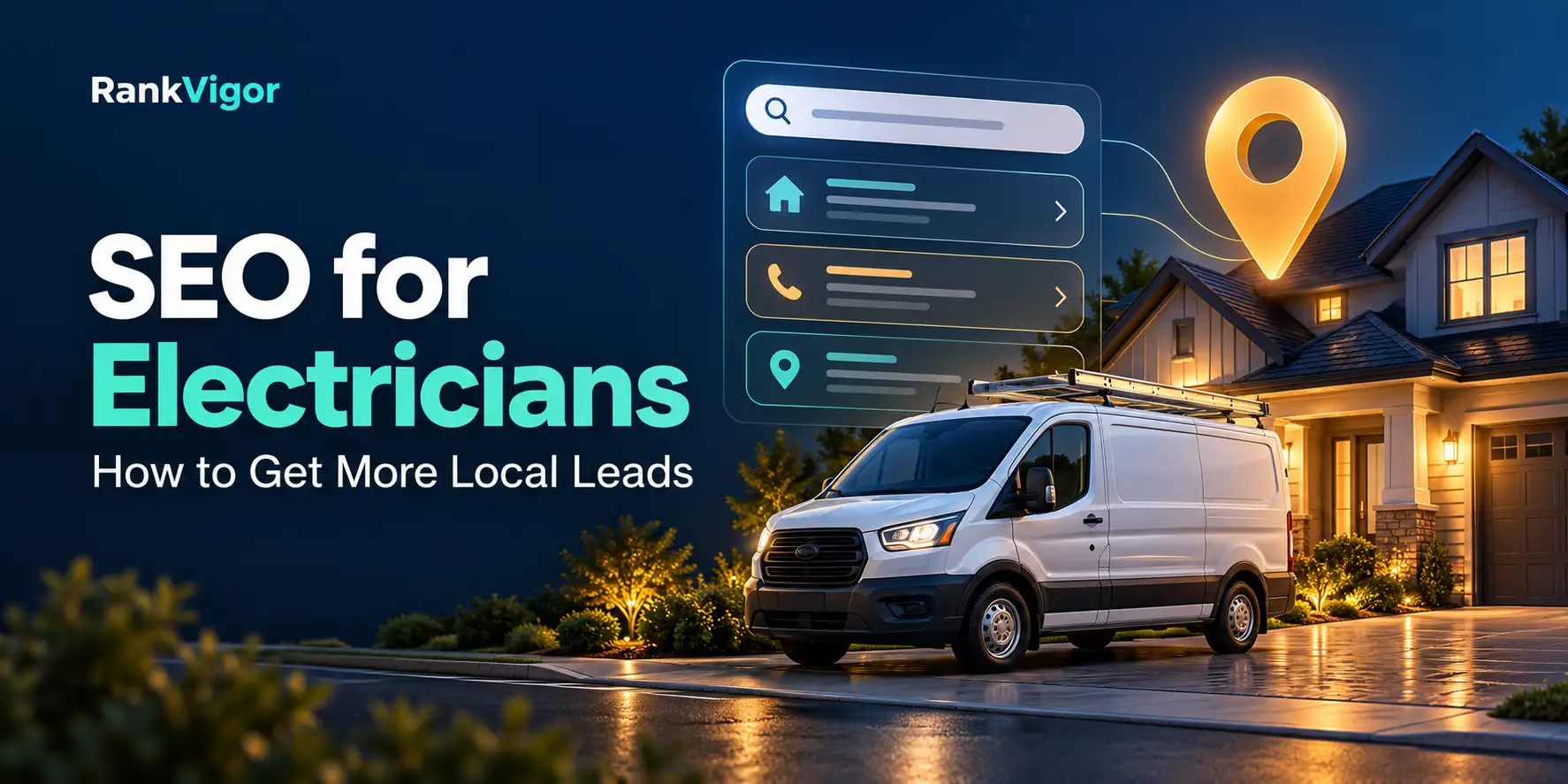
Electrician SEO helps your electrical business appear when people search for the services you offer in the areas you cover. It combines your Google Business Profile, website, reviews, and local reputation so potential customers can find you, assess your business, and get in touch.
For an electrical contractor, more traffic is only useful when it brings the right inquiries. A call about a panel upgrade inside your service area matters more than a hundred visits from people looking for a wiring diagram you cannot turn into work.
At RankVigor, we focus on real rankings, real traffic, and real leads. This guide explains where to start, which pages your website needs, and how to tell whether your SEO work is bringing you closer to booked jobs.
What electrician SEO should help you achieve
Your business can be discovered in different parts of a search results page. Local results and Maps help people compare nearby businesses. Organic website results can bring them to a specific service page or a guide that answers a question before they hire someone. Paid ads are a separate channel with a separate budget.
Google says local rankings mainly depend on relevance, distance, and prominence. You can improve how clearly your business matches a search and build its reputation, but you cannot choose where the searcher is standing. Nobody can pay Google for a better organic local ranking. Google’s local ranking guidance.
Start with a commercial decision: which jobs do you want more of, and where can your team deliver them? A contractor focused on commercial maintenance needs different pages and lead qualification from one focused on residential service calls.
1. Get your Google Business Profile right
Claim and verify your Google Business Profile, then check whether a customer can understand what you do without visiting your website.
Use your real business name. Do not add city names or “best electrician” unless they are genuinely part of that name.
Select the primary category that best describes the business, such as Electrician when appropriate. Add only relevant additional categories available in your account.
Keep your phone number, website, hours, and services accurate. Advertise emergency or 24-hour availability only when you actually provide it.
Add clear photos of your team, vehicles, and completed work with permission. Real evidence is more useful to a prospective customer than a collection of generic stock images.
If you travel to customers and do not receive them at your business address, configure a service-area profile and hide the address. Do not create a profile at a mailbox or a virtual office simply to appear in another city. Additional locations must meet Google’s eligibility rules. Business Profile guidelines.
Choose service areas that reflect your operations. Adding a city tells customers where you work; it does not remove the distance factor from local rankings. Google lets you specify areas such as cities and postal codes rather than a radius. Service-area settings.
2. Match electrician keywords to the right pages
The phrase “electrician SEO” is something a business owner searches when looking for marketing advice or help. Your own customers are more likely to search for an electrician, a specific service, or information about an upcoming project.
Build a list from your actual jobs, customer questions, and search data. Prioritize services you want to sell, not just keywords with the largest estimated volume.
| Example customer search | What the searcher needs | Best page to create or improve |
| electrician in Phoenix | A contractor serving the area | Homepage or substantive location page |
| electrical panel upgrade Phoenix | Help with a specific project | Panel upgrade service page |
| EV charger installation electrician | An installer and project information | EV charger installation service page |
| commercial electrician Phoenix | A contractor who handles commercial work | Commercial electrical services page |
| what affects the cost of rewiring a house | Information before requesting an estimate | Cost-factor guide linked to the service page |
These are illustrative keyword examples, not verified search-volume estimates. Use your own service locations and check which results appear for each query before deciding what to publish.
Keep closely related phrases on one useful page when they serve the same need. You do not need separate pages for every variation of “electrician,” “electrical contractor,” and “electrical company” in the same city.
3. Build service pages that help customers choose
A generic services list gives potential customers little help with a specific decision. Create a dedicated page for each substantial service you actually offer, such as panel upgrades, lighting installation, rewiring, or EV charger installation.
A useful service page answers six questions:
What does the service include?
Which customers and areas do you serve?
What happens during an assessment or estimate?
What factors can affect scope, cost, or scheduling?
What relevant experience and completed work can you show?
How can someone request the next step?
For example, an EV charger page could explain the information you need from the customer, your assessment process, the types of properties you serve, and how to arrange a quote. Have a qualified electrician review technical statements; a marketing page should not guess about a property’s electrical requirements.
Use a descriptive title such as “EV Charger Installation in Phoenix | Business Name” when it accurately describes the page. Keep the main heading clear and make the contact option easy to find on a phone.
Show credentials and insurance information only when they are current and accurate. Project photos should explain what the work involved without revealing customer details you do not have permission to publish.
4. Make location pages useful rather than repetitive
If you serve several nearby cities, a location page can explain your work in each area. It needs a reason to exist beyond swapping one city name for another.
Useful material includes services available there, actual projects with permission, relevant customer feedback, and an accurate explanation of how you schedule work in that area. A page can say that you serve a city without implying you have an office there.
If you have no distinct information for a location, start with a clear service-area section instead of producing dozens of nearly identical pages. Google’s spam policies identify doorway abuse as pages created to rank for similar queries and funnel people toward the same destination. Google Search spam policies.
Link location and service pages where it helps customers move between them. Avoid filling every page footer with a long list of keyword-stuffed city links.
5. Ask for honest reviews and build local credibility
Make requesting feedback part of your normal follow-up process. Share your Google review link after a completed job and invite an honest review. Keep the request simple, and do not tell customers which keywords to include.
Google prohibits incentives for reviews. Avoid discounts, gifts, or a process that directs only satisfied customers to Google while filtering out others. Respond professionally to feedback and keep private job details out of public replies. Google’s review guidance.
Also check listings that your customers may use, such as established local directories, trade associations, and chamber-of-commerce websites. Correct outdated phone numbers or conflicting business details. Prioritize relevant listings over buying hundreds of directory submissions.
Local links can come from real relationships: a supplier listing, a community project, or a trade association you actually belong to. Do not buy ranking links or invent partnerships. The useful question is whether the mention makes sense for your business and its audience.
6. Fix the website issues that lose inquiries
Open your website on a phone and act like a first-time customer. Can you identify the service area, find the right service, and contact someone without fighting pop-ups or a slow page?
Start with these checks:
Make the phone number tappable and the estimate form easy to complete.
Explain what happens after someone submits the form. Avoid response-time promises the team cannot keep.
Check that forms reach the right inbox and that someone handles missed calls.
Compress oversized images and keep the mobile layout readable.
Use Search Console to inspect important pages and check for accidental indexing restrictions.
Fix broken links and link relevant guides to their corresponding service pages.
These checks support both discovery and customer experience. Google’s SEO Starter Guide explains the fundamentals of helping search engines find and understand your content.
Appropriate local-business structured data can describe public business information, but it should match what visitors see. Validate it against the relevant requirements and do not treat it as a ranking guarantee. Never invent a public address to satisfy a plugin field. LocalBusiness structured data guidance.
7. Publish content that supports real buying decisions
Write about questions your team answers before a job is booked. Good starting points include what happens during an electrical estimate, what affects project pricing, how to prepare for a scheduled visit, and how homeowners can compare contractor proposals.
Each guide should connect naturally to a relevant service. A rewiring cost-factor article can lead to your rewiring page; it should not send every reader to an unrelated general contact page.
Use original explanations from your team and real examples where you have permission. Do not present generated project photos as completed work. Avoid publishing detailed electrical repair instructions merely to attract traffic from people who have no intention of hiring a contractor.
For a broader review of the local-search foundation, work through our local SEO checklist.
How to measure electrician SEO beyond rankings
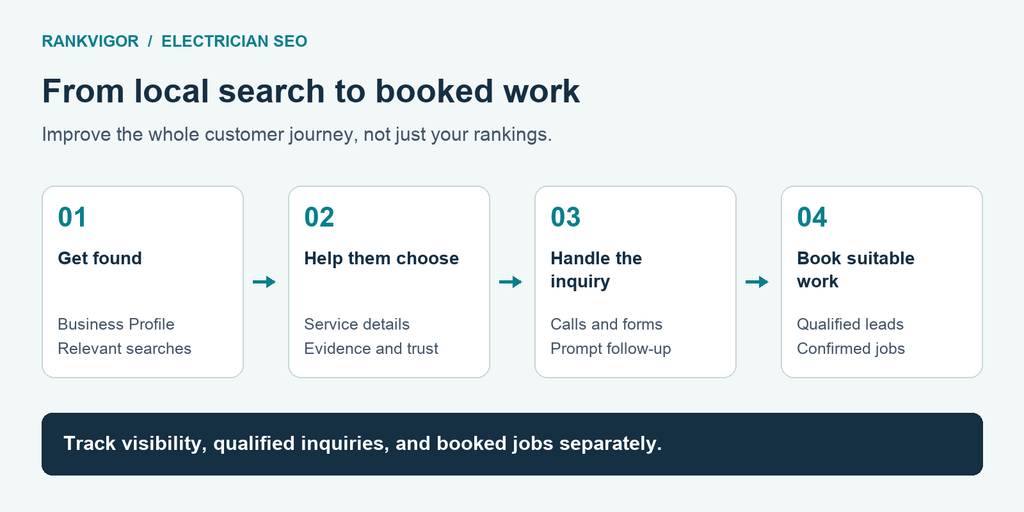
Track the path from discovery to completed business outcomes. Search visibility matters, but the business also needs suitable inquiries and the capacity to respond to them.
Record organic search traffic to priority pages, valid phone and form inquiries, qualified leads, booked jobs, and revenue where your records allow it. Separate paid advertising from organic results. Treat a click on a phone button as an interaction, not proof that a call connected or a job was booked.
Use a consistent definition of a qualified lead, such as someone asking for a service you offer in an area you cover. Note why inquiries were unsuitable: outside the service area, wrong type of work, spam, or unavailable scheduling.
For illustration, if 20 qualified inquiries lead to five booked jobs, the booking rate is 25%. That is an example calculation, not an industry benchmark. A fall in bookings could reflect response handling, pricing, or capacity as well as marketing quality.
Review the same service and location groups over time. One search from your office is not a complete picture of local visibility across your market.
When to hire an electrician SEO agency
You may be able to handle accurate business details, review requests, and basic page improvements yourself. An agency can help when technical problems, content production, or measurement exceed the time and skills available in your team.
Before hiring, ask:
Which services and locations will you prioritize, and why?
What specific pages or technical issues will you work on first?
How will you distinguish qualified leads from general traffic?
Will we retain control of our website, Business Profile, and analytics accounts?
What is included in the fee, and what costs extra?
Can you explain relevant results without promising we will get the same outcome?
Be cautious about guaranteed first-place rankings, fake locations, purchased reviews, or reports that never connect activity to business outcomes. A low keyword-difficulty score from a tool does not establish that your local competitors will be easy to outrank.
RankVigor’s local SEO services bring together the profile, website, and local-search work behind this approach. Start with the gaps affecting your business rather than buying a fixed quantity of blog posts or backlinks.
Your first 30 days
Use the first month to build a foundation and a baseline, rather than expecting a guaranteed ranking jump.
Week 1: Check your Business Profile, contact details, service areas, and lead handling. Record current traffic and qualified inquiries.
Week 2: Improve the pages for two or three priority services. Make the scope, evidence, and next step clear.
Week 3: Fix important mobile or indexing issues, correct major listings, and put an honest review-request process in place.
Week 4: Publish one useful customer-question guide, add relevant internal links, and review the quality of incoming inquiries.
Choose the next month’s work from what you learn. A contractor losing calls needs a different next step from one whose most important service page cannot be indexed.
Frequently asked questions
How long does electrician SEO take?
There is no fixed timeline. It depends on your starting point, competitors, website, and the work required. Google says some SEO changes can show effects within hours while others take several months. Review trends over time rather than judging the whole investment from a few days of rankings. SEO Starter Guide.
How much does SEO for electricians cost?
There is no single price that fits every contractor. The scope changes with the number of locations, website condition, content needs, and competition. Ask for an itemized proposal showing setup work, ongoing deliverables, reporting, and any separate advertising or website costs.
Can an electrician rank without a storefront?
An eligible service-area business can have a Google Business Profile without receiving customers at its address. Follow the address-hiding and eligibility rules. You do not need to invent a public office to participate.
Do I need a page for every city I serve?
No. Create a separate page when you can provide useful, distinct information for that area. A well-written service-area section is a better starting point than many duplicated city pages.
Should I use SEO or Google Ads?
They serve different roles. Ads buy placement and require ongoing spend. SEO develops organic discovery and needs ongoing work too. Choose the mix based on urgency, budget, job value, and your ability to handle inquiries, then measure each channel separately.
Find the gaps costing you local leads
Electrician SEO works best as a connected process: accurate local information, useful service pages, credible evidence, and a reliable way to turn inquiries into booked work. Start with your most valuable services and improve the steps that are currently weakest.
Want a second pair of eyes? Get a free 5-minute video audit from RankVigor. We will walk through your rankings and the fixes that matter, delivered in 48 hours with no sales call required.