
To choose an SEO agency, define the business result you want, shortlist providers with relevant experience, and compare their proposals against the same requirements. Look for a clear plan, evidence you can examine, realistic expectations, and an agreement that explains who owns the accounts and completed work.
This guide is for small business owners comparing SEO providers, especially local service businesses. The sales presentation is only the beginning. Before you hire, find out who will work on your website, who will implement changes, and how you will judge progress. An attractive monthly fee tells you little if essential tasks are excluded.
This guide gives you 15 questions to ask an SEO agency, a practical comparison table, and a final checklist for deciding whether to proceed. If you are still deciding whether you need outside help at all, start with what an SEO agency does.
Start with your business goal and constraints
Write a short brief before contacting agencies. Explain what you sell, where you serve customers, and which inquiries or sales you want more of. Add the budget you can sustain and the support your team can provide.
For example, a local contractor might want more qualified replacement estimates in its actual service area. That is a more useful brief than “rank for every roofing keyword.” It gives the agency a reason to prioritize the right service pages, local information, and lead measurement.
Your brief should also mention planned website changes, previous SEO work, and any immediate concerns. If your developer only has a few hours available each month, a proposal that depends on a major rebuild needs a different implementation plan.
A brief you can copy into your inquiry
Send the same completed brief to each candidate:
- Business and website: [your business name and URL].
- Customers and service area: [who you serve and where].
- Main goal: [the inquiries, bookings, or sales you want to improve].
- Current situation: [previous SEO work, known problems, and upcoming website changes].
- Budget and scope: [the monthly or project budget you can sustain].
- Internal support: [who can approve content and implement website changes].
- Starting point: [available search traffic and lead data, or a note that tracking needs setup].
Choose the type of help you need. An ongoing agency retainer can suit recurring work across several areas. A consultant or a fixed technical project may be enough for a specific problem. Our local SEO checklist can help a service business identify what it already handles and where it needs support.
Build a shortlist you can actually compare
Look for providers that understand your business model, market, and website platform. Exact industry experience can help, but a provider's explanation of a comparable problem is more useful than a long list of client logos.
Referrals, public examples, and professional recommendations can help you identify candidates. An agency's own rankings, awards, or reviews can inform the shortlist, but none independently proves that its assigned team will meet your needs.
Send each candidate the same brief. Ask for a discovery conversation and a written proposal. Comparing two or three well-matched providers is often more manageable than collecting many unrelated packages.
Google's guidance on hiring an SEO encourages interviewing candidates, checking references, and questioning guaranteed rankings. Use those checks alongside your own requirements.
15 questions to ask before hiring an SEO agency
Use these questions as a conversation guide. Follow up on answers that sound convincing but leave the actual work unclear.
1. What would you prioritize for our business and why?
Ask the agency to explain its initial priorities in terms of your customers and business goal. A useful answer connects an observed issue to a page, an audience, or a missed opportunity.
The agency does not need to deliver an entire strategy for free. It should, however, explain how it will investigate the site and decide what matters. Be cautious if the recommendation is the same number of posts and links before anyone has discussed your business.
2. What relevant work can you show us?
Request an example that matches a meaningful part of your situation: a similar service model, website platform, local market, or technical obstacle.
Ask what the starting point was, what the agency changed, and what the measurement period covered. A traffic graph needs context. Ask whether the graph shows organic search traffic or total traffic. Seasonality, tracking changes, and increased searches for the brand can affect the story; a total-traffic graph may also include paid campaigns. Confidential client details can remain private while the agency explains the work and its limits.
3. Can we speak with a client reference?
Ask for a reference with the client's permission. Discuss communication, delivery, implementation, and whether the work addressed the client's actual needs.
Useful questions include whether the team explained delays, kept a record of changes, and handled disagreements constructively. A reference is one piece of evidence, not a guarantee that your project will produce the same result.
4. Who will do the day-to-day work?
Find out whether the person selling the service is also your strategist. Ask who handles content, technical checks, outreach, and account communication, including any subcontractors.
You are evaluating the delivery team as well as the agency. Ask who covers the account if your usual contact is unavailable and how decisions move between specialists. Outsourcing is not automatically a problem; unclear accountability is.
5. What will we receive and what is excluded?
Ask for named deliverables and their approval process. “Content SEO” might mean a topic plan, drafts, edits to existing pages, or publication. Those are different commitments.
Clarify whether research, writing, fact-checking, images, design, uploading, and revisions are covered. List additional fees separately. If the proposal includes a monthly volume, ask how the agency will handle a month when a technical issue deserves priority over another article.
6. Who implements and verifies website changes?
Ask whether the agency edits your site or sends recommendations to your developer. If development is separate, find out how work is estimated, approved, and checked after deployment.
A report identifying an indexing problem does not resolve it. Ask for a process that distinguishes proposed, approved, implemented, and verified tasks. That makes it easier to understand what is holding up progress.
7. How will you select keywords and pages?
Ask the agency to explain a sample topic and the page that should address it. Look for attention to customer intent, relevance, and your ability to deliver the service.
For instance, a question about repair costs may need an explanatory guide, while a search for a nearby provider needs an appropriate service page. Ask how the agency avoids overlapping pages targeting the same need. Search volume alone is not a sufficient business case.
8. How do you create and review content?
Find out who supplies subject expertise and who checks facts before publication. The agency should have a way to capture your actual process, qualifications, product details, and approved examples.
Ask how AI tools are used and how drafts are edited. Google's people-first content guidance emphasizes useful, reliable content. A promise to produce hundreds of generic pages should prompt questions about originality, relevance, and quality control.
9. How do you obtain links?
Ask for examples of the kinds of sites and relationships involved. Clarify what you are paying for: research, a useful resource, outreach, an advertisement, or a guaranteed placement.
An agency should explain its methods rather than promising a large link count without context. Google's spam policies address link manipulation. Avoid providers that depend on undisclosed link networks or placements intended primarily to manipulate rankings. Paid advertisements and sponsorships are different: Google permits those links when they are qualified with rel="sponsored" or rel="nofollow" so they do not pass ranking credit. Ask who checks that qualification.
10. How will you measure success?
Agree on measures appropriate to your goal. Search clicks and rankings can show visibility, while qualified inquiries, booked jobs, and sales help assess business value when the data is available.
Ask how tracking will be checked and how the agency will separate paid from organic results. Google's Search Console performance report describes search metrics, but it does not by itself establish revenue. A report should explain limitations as well as positive trends.
11. What expectations and review points are realistic?
Ask for a proposed work sequence, dependencies, and dates for reviewing progress. Separate a delivery commitment, such as completing agreed page updates, from a prediction about rankings or leads.
Google's SEO Starter Guide explains that changes can take from hours to months to show effects, and some may have no noticeable impact. A provider should discuss uncertainty and what it will investigate if progress is slower than expected.
12. What accounts and materials will we own?
Confirm control of the domain, website, Business Profile, and measurement accounts. Ask how access will be granted and what happens to published content, working files, and reporting history when the relationship ends.
Keep ownership with your business and use named user accounts. Google's Search Console permissions guide explains its access roles. During a preliminary audit, Google's hiring guidance recommends read access rather than write access. Implementation permissions can be agreed when the scope requires them.
13. How will you communicate and record changes?
Ask who your contact is, how often you will meet, and what response times are included. Request a sample report with private information removed.
Look for a completed-work record, results with context, upcoming priorities, and tasks waiting on your team. Ask how urgent issues are raised. A dashboard is useful, but it should not be the only explanation you receive.
14. What does the agreement say about cost and leaving?
Read the minimum term, renewal process, notice period, payment schedule, and any setup or handover charges. Confirm which work stops when the agreement ends and what materials you receive.
Compare the total commitment for the term under consideration, including separately billed development or content. Get ambiguous terms explained in writing before signing. A month-to-month arrangement and a longer engagement both need clear scope and exit expectations.
15. What does your AI search service actually include?
Agencies may use AEO (answer engine optimization) or GEO (generative engine optimization) for work intended to improve visibility in AI-generated answers. The labels alone do not define a deliverable. Ask the agency to translate them into specific tasks, outputs, and measurement limits. Improving content clarity is a concrete task; promising that every AI system will recommend you is not.
Google's AI search guidance says its existing SEO fundamentals remain relevant and special schema is not required for its AI features. Ask how the proposed work aligns with that guidance rather than accepting an unexplained extra fee.
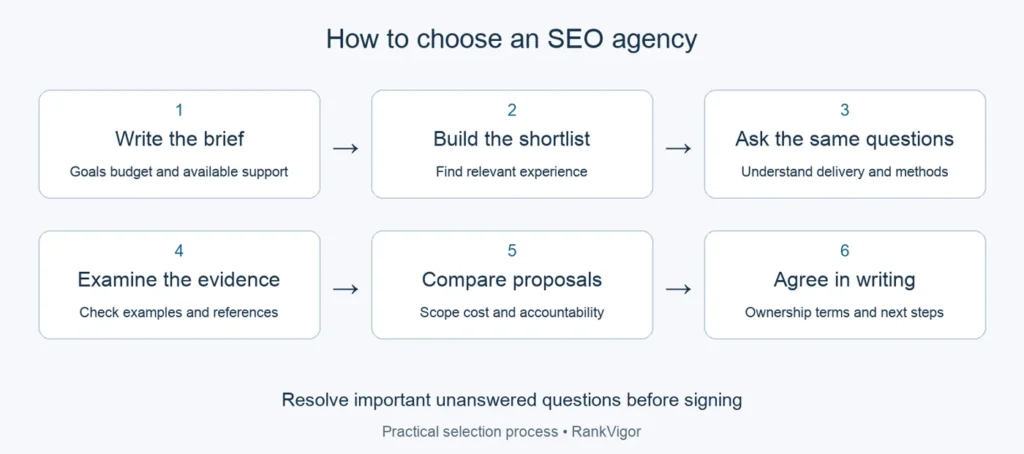
Compare the proposals side by side
After the calls, put each proposal into the same comparison format. Record evidence and unresolved questions rather than relying on a general impression.
| Compare this | Record for each agency | Resolve before signing |
|---|---|---|
| Business fit | Similar work and the problem it addressed | How that experience applies to you |
| Plan | Priorities, deliverables, and dependencies | What is included in the initial scope |
| Delivery | Named team and implementation owner | Who checks completed work |
| Methods | Content review and outreach approach | Any unexplained tactics or fees |
| Measurement | Goal, baseline, and sample report | Tracking gaps and attribution limits |
| Cost | Fees, exclusions, and minimum commitment | Extra charges and payment terms |
| Ownership and exit | Account control and handover details | Access and materials after departure |
Mark a row “clear,” “needs clarification,” or “does not meet our requirement.” Use the labels to identify unresolved questions. Decide which requirements are essential before comparing the answers. An agency should not win because it answers more easy questions if it fails a critical ownership or delivery requirement.
For example, Proposal A might include writing four articles but leave uploading and technical implementation to you. Proposal B might include fewer new articles plus approved service-page updates and live fixes. Neither is automatically better. Your brief, resources, and current obstacles determine which scope is more useful.
If a price difference comes from excluded work, compare again after accounting for the resources needed to complete it. Do not assume the cheaper proposal buys the same service.

Red flags that deserve a closer look
Some concerns justify ending the conversation; others need a direct follow-up question.
- Guaranteed number-one organic rankings or claims of a special Google relationship. Google explicitly warns against ranking guarantees in its hiring guidance.
- Refusal to explain methods, identify the delivery team, or document the scope.
- Pressure to sign before you can review the proposal and agreement.
- Reporting that blends ad results with organic results without explaining the difference.
- An agency-controlled domain or essential account with no clear ownership and handover arrangement.
- Large content or link quotas with no explanation of relevance, quality, or purpose.
A low price is not proof of poor work, and a high price is not proof of expertise. A smaller provider can be a good fit if its scope is realistic and accountability is clear.
Final checklist before signing
Check each item against the written proposal and agreement:
- The business goal and initial scope are stated clearly.
- Relevant examples or references have been examined.
- The delivery team and person responsible for implementation are named.
- Deliverables, exclusions, approvals, and additional fees are documented.
- Measurement, review dates, and reporting responsibilities are agreed.
- Your business controls its essential accounts, and content ownership is clear.
- The minimum term, renewal, cancellation, and handover process are understood.
- Important questions about methods or promises have been resolved.
If an essential item is still unclear, request an updated proposal before signing. Then keep that version as the reference for kickoff and later reviews.
Make the decision and document the starting point
Before hiring an SEO agency, confirm that the proposed work addresses your brief, the team can deliver it, and you can provide the approvals and resources it requires. Get any remaining clarifications into the proposal or agreement.
At kickoff, record the baseline, initial priorities, account access, approval process, and reporting schedule. Identify the person responsible for each dependency. You should know what happens next without having to infer it from the sales deck.
If none of the proposals fits, revise the brief or choose a smaller project. It is reasonable to postpone an ongoing commitment when the need, scope, or implementation plan is still unclear.
Frequently asked questions
What should I look for in an SEO agency?
Look for relevant experience, an understandable plan, transparent methods, implementation accountability, useful reporting, and clear ownership terms. Examine examples and the assigned team rather than choosing on price or presentation alone.
How much should I budget for hiring an SEO agency?
Start with a budget your business can sustain and compare proposals with similar scopes. Fees vary with the work, market, site complexity, and implementation responsibilities. Include setup fees and separately billed services when assessing the full commitment.
Should I choose a local SEO agency?
A nearby agency may make collaboration easier, but location alone does not establish fit. Ask how it understands your customers and service area. A remote specialist with relevant experience may also be suitable.
Can an SEO agency guarantee results?
It can commit to agreed work and service standards, but it cannot guarantee a number-one Google ranking. Ask what a “results guarantee” covers, how it is measured, and what happens if the promised condition is not met.
Should I sign a long-term SEO agreement?
Consider whether the scope, budget, and review process justify the commitment. A longer term does not remove the need for clear deliverables and progress discussions. Read the renewal, cancellation, and handover provisions before deciding.
How do I know if an agency is a good fit after kickoff?
Check whether it delivers the agreed work, explains decisions, flags obstacles, and reports results with context. Review meaningful trends at the agreed checkpoints. If there is a problem, ask for a specific correction plan rather than relying on reassurance.
Get a clearer starting point for your website
Choosing an SEO agency is easier when you understand the problems you need it to solve. Use the same brief, examine the evidence, and resolve scope and ownership questions before committing.
If you want an initial view of your website's search visibility, request RankVigor's free SEO audit. Use the findings as a starting point for discussing priorities and a suitable scope of work.