Your franchise can have a recognizable brand and still be hard to find when someone nearby needs your service. A customer searching for “auto repair in Raleigh” needs the right shop, its hours, and a way to book. A corporate homepage rarely answers all three.
Franchise SEO connects your brand website, local pages, and Google Business Profiles so customers can find and contact the location that serves them. The work includes national website improvements, but success needs to be measured at the location level: qualified calls, appointments, orders, and revenue where attribution is available.
This guide explains how to build that system, divide responsibilities between headquarters and franchisees, and prioritize the fixes that matter. It focuses on attracting local customers. Recruiting people who want to buy a franchise requires a separate content strategy.
What is franchise SEO?
Franchise SEO is search engine optimization for a business operating under one brand across multiple independently owned or managed locations. It helps the brand appear for relevant searches while giving each location a useful, accurate presence in its own market.
SEO for franchises usually involves three connected parts: a technically sound brand website, pages that answer local customer needs, and eligible business listings supported by genuine reviews and accurate information.
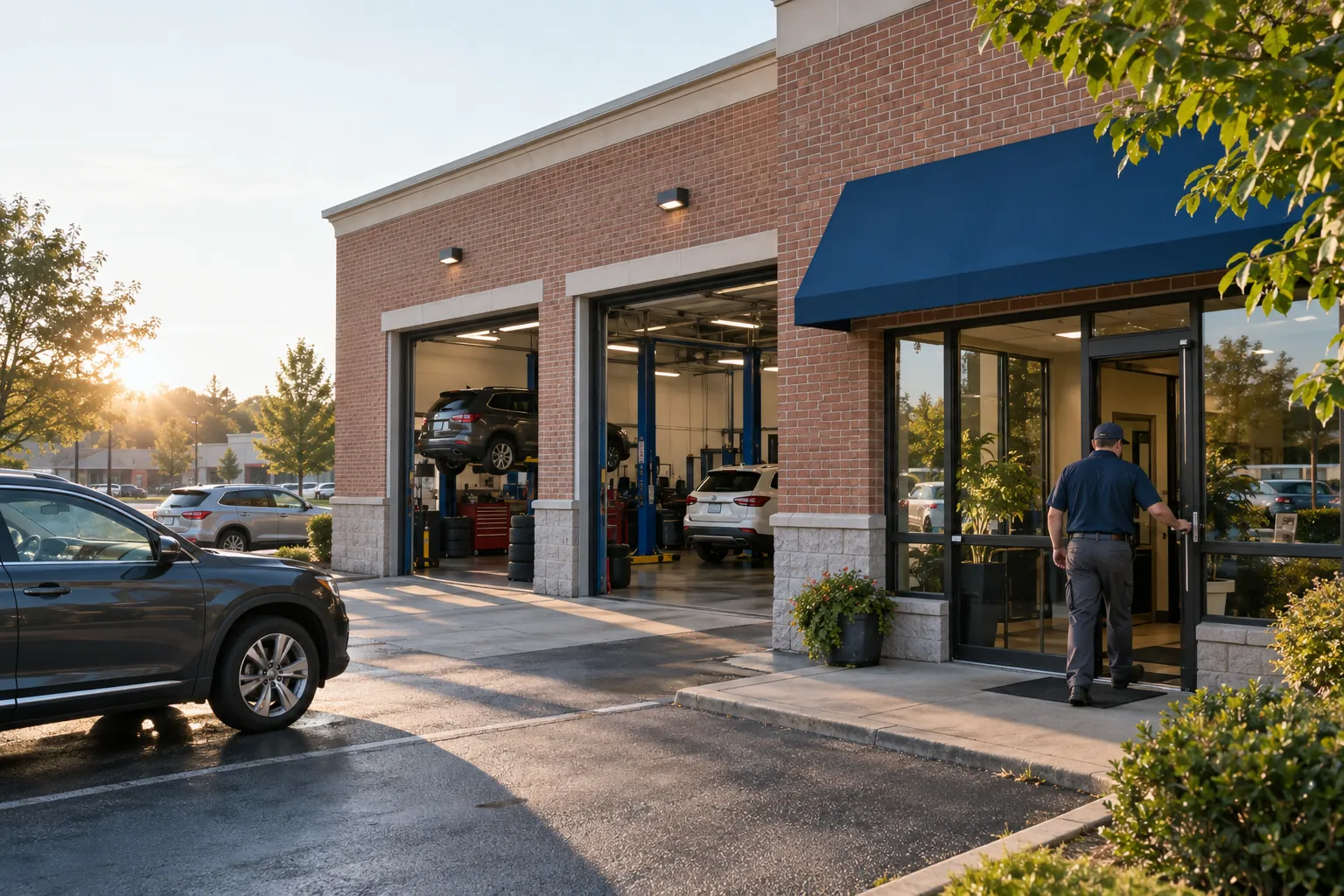
For a hypothetical repair franchise, an article about brake warning signs might attract an early research query. A Raleigh location page should help someone looking for a nearby repair shop. A Google Business Profile helps customers find that shop in Maps. Those assets serve different needs, even though they belong to the same brand.
Why each location needs its own strategy
One branch may have an established team, accurate listings, and a strong review history. Another may have changed phone numbers or opened recently. A single national traffic report can hide these differences.
Google explains that local results depend mainly on relevance, distance, and prominence or popularity. You can improve the information and credibility of a location, but you cannot make every branch the closest business to every searcher. A franchise agreement also does not reserve Google rankings within a territory.
Separate map visibility from website visibility when planning. Business Profiles help with local results, while crawlable, useful pages give your website a chance to appear in organic results. Neither guarantees the other. Our guide to improving Google Maps rankings explains the local side in more detail.
1. Map customer searches to the right pages
Start with what each branch actually offers. A location that does not provide emergency repairs should not target emergency repair searches just because another franchisee does.
Group searches by the customer's next step:
- Research: “why are my brakes squeaking” belongs in a helpful educational guide.
- Local service: “brake repair Raleigh” belongs on a useful local service or location page.
- Brand and location: “[brand] Raleigh hours” needs the correct branch details.
- Franchise investment: “[brand] franchise cost” belongs in the recruitment section, separate from customer pages.
Use Search Console queries, customer calls, local competitor pages, and keyword research to identify gaps. Do not treat national search volume as proof that a topic will generate leads in every city.
Assign one main page to each distinct need. If the Raleigh location page already explains brake repairs well, creating another thin page for the same search may add confusion. A dedicated service page is useful when customers need substantial extra detail, such as service scope, appointment requirements, or local availability.
2. Choose a website structure you can maintain
For many franchises, location pages within the main brand website are a practical starting point. They make it easier to maintain templates, internal links, and shared reporting. This is an operational recommendation, not a Google rule that one domain always ranks better.
A simple structure might include a locations directory, an individual branch page, and shared service guides. For example: /locations/, /locations/nc/raleigh/, and /services/brake-repair/. The exact folder pattern matters less than clear navigation and pages that meet different needs.
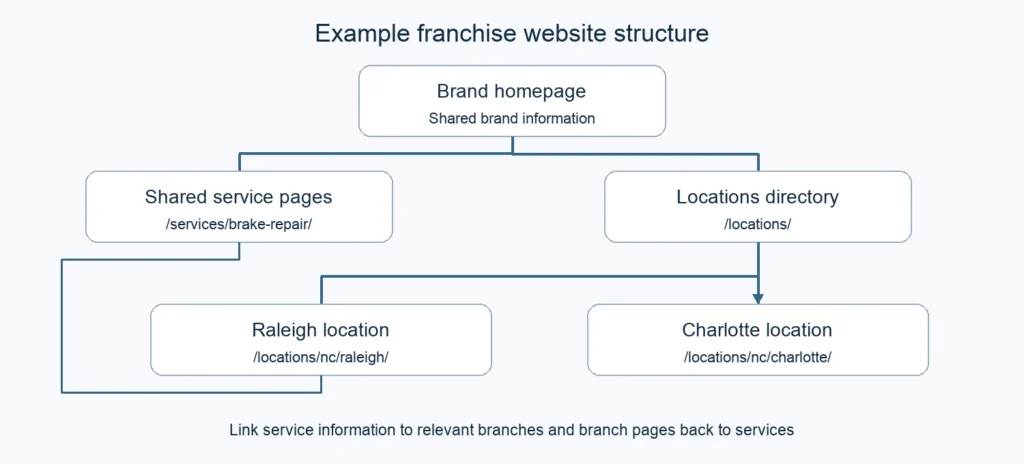
Separate franchisee websites can work when the franchise agreement permits them and each site has enough resources to maintain useful content. They also create more work: separate technical checks, analytics, ownership, and local content management. Audit an existing network before deciding to merge or move sites; migration can affect traffic and requires its own plan.
Do not automatically point every location page's canonical tag at the corporate homepage. If a branch page is intended to appear in search as a distinct destination, review its canonical and indexing settings accordingly. Keep outdated URL variations from competing with the current branch URL.
3. Build location pages customers can actually use
A strong location page lets someone decide whether this branch is right for them and take the next step without searching elsewhere.
Include the branch's accurate name, relevant contact details, hours, services, and booking options. For customer-facing premises, add the address, directions, parking or accessibility information, and genuine photos. For a service-area operation, explain the area served and how appointments work without implying there is a public storefront.
Useful local differences can include the team, services available only at that branch, real project examples with permission, local offers, and questions customers regularly ask. Shared brand information can remain consistent. There is no useful rule that a fixed percentage of every page must be rewritten.
Consider a hypothetical Raleigh auto-service page. A title such as “Auto Repair in Raleigh, NC | [Brand]” makes the service and location clear. The page could explain which repairs are offered, whether appointments are required, Saturday opening hours, and how to reach the entrance. These details help a customer more than several paragraphs repeating “best auto repair Raleigh.”
Avoid publishing hundreds of pages that simply swap city names and send everyone to the same generic destination. Google's spam policies address doorway pages and scaled content created primarily to manipulate rankings. A page should earn its place by helping someone in that market.
4. Manage Google Business Profiles by eligible location
Local SEO for franchises needs a reliable Business Profile process. Search for existing profiles before creating new ones, confirm who has access, and keep the business's authorized owners involved. Give people individual access rather than sharing one login across the franchise network.
Google's business representation guidelines require accurate real-world names. Equivalent chain locations should use consistent names and core categories, subject to genuine differences in how the businesses are represented. Do not add a city or service keyword to the name purely for ranking.
For each eligible branch, check the phone, hours, website link, services, category, and verification status. Link to the relevant location page so a customer lands on the branch they selected. Additional categories should reflect services actually offered there.
Storefronts and service areas need different treatment
A shop that receives customers at a staffed, eligible location differs from a cleaning or repair business that visits customers. A service-area business should hide its address when customers are not served there. Do not use virtual offices or create profiles for every town within one branch's territory.
Multiple separately staffed operating locations may qualify for separate profiles when they meet Google's requirements. An exclusive territory alone does not establish eligibility. Check the service-area guidance before adding profiles.
Bulk verification is conditional
Google provides a bulk verification process for qualifying businesses with at least 10 eligible profiles from the same business. Ten franchise territories do not automatically qualify. Service-area-only businesses are excluded from that bulk route; customer-facing hybrid operations require careful eligibility review. Existing ownership, errors, and evidence requirements can also affect the process.
For the ongoing optimization steps, use our Google Business Profile guide. Keep an inventory of access, verification, and unresolved issues for every branch.
5. Give headquarters and franchisees clear responsibilities
Franchise SEO stalls when everyone assumes someone else will update a closed branch or changed phone number. Agree on responsibilities before scaling the work.
Headquarters can own website templates, technical maintenance, approved branding, reporting standards, and escalation procedures. Franchisees should supply the local facts: hours, services, team information, genuine photos, and changes to operations. Whoever manages reviews needs a named backup and a clear response policy.
Keep a master location record with a stable branch ID, current URL, profile link, public phone, opening status, and responsible person. Treat it as the source for updates across the website and listings. Set an agreed deadline for reporting changes; temporary closures and holiday hours should be updated before customers make a wasted trip.

If you are a franchisee with limited website access, start with the assets you are authorized to manage. Correct local information, request page improvements from headquarters, and establish reliable lead reporting. Check brand rules before launching a separate website or changing business names.
6. Build genuine reviews and useful local mentions
Create a consistent process for requesting honest reviews after real customer interactions. Give each branch its own review link so feedback goes to the location the customer used. Respond professionally and keep private customer details out of public replies.
Google prohibits incentives in exchange for reviews. Its Maps content policy also prohibits selectively soliciting positive reviews or discouraging negative ones. Do not ask only satisfied customers to review while routing everyone else away from Google.
Reviews can help customers choose a branch, but a review request system does not guarantee a ranking position. Investigate repeated complaints as operational problems, not just marketing problems.
Keep important listings accurate on platforms relevant to your audience, such as Apple Maps, Bing Places, Yelp, and industry directories. Prioritize correct branch details and remove outdated duplicates through each platform's process. Buying large quantities of low-quality directory links is not a substitute for useful local visibility.
Look for genuine local relationships: chamber memberships, supplier partnerships, community involvement, or newsworthy projects. When a local organization mentions a branch, the branch page may be the most useful link destination. Do not invent sponsorships or customer stories to make a page appear local.
7. Keep location pages discoverable and easy to use
A polished page cannot help much if search engines cannot access it or mobile visitors cannot contact the branch. Check the shared template as well as individual pages.
- Confirm intended search pages return a working response and are not accidentally blocked or marked noindex.
- Include branch URLs in a sitemap and accessible navigation. A store locator should offer crawlable links rather than rely entirely on an interactive map.
- Link shared service guides to relevant branches and branch pages to useful service information.
- Make phone and booking controls easy to use on mobile; test that inquiries reach the correct branch.
- Compress images, provide appropriate alt text, and avoid heavy features that make basic location details difficult to load.
Where applicable, add accurate LocalBusiness structured data for the branch, matching visible information. Use Google's LocalBusiness documentation and test the implementation. Markup does not guarantee enhanced search appearances or higher rankings. Do not copy a storefront address into markup for a business that does not publicly serve customers there.
When a branch moves or closes, coordinate the website and listing updates. Redirect an old URL only when there is a genuinely appropriate replacement. Otherwise, provide a useful closure notice or handle removal appropriately; sending every closed location to an unrelated branch can mislead customers.
8. Measure leads separately for each location
Total organic traffic is useful context, but it can conceal a weak branch. Review location-page performance alongside the inquiries and sales that branch receives.
Use Search Console to monitor relevant queries and pages, analytics to track website actions, and Business Profile performance to understand available profile interactions. Add consistent campaign tags to profile website links if your analytics setup supports them. Compare the same metrics over time and account for seasonal demand.
A phone-button click is not necessarily a completed call. A form submission is not necessarily a qualified lead. Where possible, connect inquiries to answered calls, booked appointments, and sales in the CRM. Keep reporting privacy-conscious and avoid counting the same lead twice.
For call tracking, choose an implementation that preserves accurate branch contact information and follows platform rules. Test routing before using the numbers. Local rank tracking can help diagnose visibility, but results vary with the searcher's location; one ranking screenshot cannot represent an entire territory.
If traffic rises but bookings do not, inspect service availability, page clarity, booking friction, and missed calls. The problem may need an operational fix rather than more content.
A practical first 90 days
Treat this as an implementation sequence, not a promise of ranking improvements within 90 days.
Days 1 to 30: Establish the facts
Inventory branches, pages, profiles, and access. Record baseline traffic and qualified leads. Fix inaccurate hours, broken contact paths, duplicate records, and obvious indexing issues. Choose a small pilot group that represents different markets and operating models.
Days 31 to 60: Improve the pilot locations
Upgrade pages with useful local information, align eligible profiles, correct important listings, and launch a compliant review request process. Test reporting and lead routing. Document which tasks headquarters can standardize and which require local input.
Days 61 to 90: Expand what works
Review pilot results and implementation issues. Apply the improved template to more branches while preserving their actual differences. Prioritize locations with clear gaps and genuine demand. Assign an ongoing owner for updates and monthly performance reviews.
Our local SEO checklist can support the branch-level checks. New domains, competitive markets, and limited local content may require a longer runway before meaningful growth appears.
When to hire a franchise SEO agency
Consider outside help when the network lacks the capacity to maintain profiles, improve the website, or explain performance by branch. Evaluate the proposed scope rather than a promise to rank every location first.
Ask how the agency will handle profile ownership, franchisee approvals, service-area eligibility, location content, and tracking. Request a sample location report and a clear explanation of implementation costs. Clarify who retains accounts, pages, and data if the contract ends. Cost depends on the number of branches, existing problems, and ongoing work; a credible quote should explain those drivers.
RankVigor's local SEO services cover local keyword research, location pages, citations, and Maps optimization. For a franchise, the scope should reflect the actual branch network and access available.
Frequently asked questions
Does each franchise location need a separate website?
No. Many franchises can use individual location pages within a shared brand website. Separate sites may make sense under some franchise models, but they need independent maintenance and a clear strategy. Choose based on control, resources, and customer needs rather than assuming separate domains improve rankings.
Can every franchise location have a Google Business Profile?
Each location must meet Google's eligibility requirements. Customer-facing premises and service-area operations have different rules. A territory, mailbox, or virtual office alone does not justify another profile.
Can franchise locations share the same page content?
They can share accurate brand and service information. Each page should also contain the details customers need about that branch. Reusing a template is reasonable; publishing pages with no useful local differences is not a strong strategy.
How long does franchise SEO take?
There is no fixed timeline. Correcting contact details can improve the customer experience as soon as updates appear, while growing organic visibility depends on competition, site condition, content, and local credibility. Judge progress through completed fixes and qualified leads over time rather than a guaranteed deadline.
How is franchise SEO different from franchise recruitment SEO?
Customer-focused franchise SEO helps people find and buy from local branches. Recruitment SEO targets prospective franchise owners researching investment, requirements, and opportunities. Keep those journeys separate so customer searches reach customer pages.
Start with the locations that need help most
A useful franchise SEO system makes each branch easy to find, accurate to evaluate, and simple to contact. Start with the location inventory and the customer journey, then improve the pages, profiles, and reporting that support them.
Want a clearer view of the gaps? Request a free SEO audit from RankVigor. Share your website and mention the locations you want to prioritize so the discussion starts with your actual business.