
Contractor SEO is the work that gets a construction or home-service company found on Google when people search for the jobs it actually does. It comes down to four things: an accurate Google Business Profile, one useful page for each service, proof of real work and reviews, and a simple way to request an estimate.
The goal isn't more traffic. It's more of the right inquiries. A remodeler who wants whole-kitchen projects needs a different plan from a roofer taking urgent leak calls, or a general contractor bidding on commercial work. This guide shows what most contractor websites are missing, then walks through the fixes in the order we would do them.
What we found on 92 contractor websites
In early November 2026 we checked the homepages of 92 small contractors: 42 roofers in Atlanta, Dallas and Denver, and 50 electricians around Houston, Charlotte and Tampa. We pulled them from Google Maps and looked only at what a visitor and Google can see on the page. Most of these gaps take an hour or less to fix.
The biggest gap is the simplest one. On 38 of the 92 homepages (41%), neither the page title nor the main heading named a town or city the company serves. Titles like "Home - Company Name" tell Google nothing about where you work, and location is one of the three things Google uses to rank local results.
Roofers did worse than electricians here: 22 of 42 against 16 of 50. The other gaps were common across both trades:
- 20 homepages (22%) had two or more main headings, usually a slider or logo marked up by mistake.
- 17 homepages (18%) had no link we could find to a separate service page.
- 15 homepages (16%) had no meta description, so Google writes the search snippet itself.
One note on method: we read the HTML of each homepage, so menus that load with JavaScript can hide some links. The service-page number may be a little low. The sample is small contractors, not the biggest names in each market.
How contractor SEO works
When someone searches for a nearby contractor, they can see map results, ordinary website results and paid ads. Your Business Profile mostly drives the map results, and your website mostly drives the rest, but each one supports the other.
Google says local rankings depend mainly on relevance, distance and prominence. Accurate details show relevance. Distance is how far the searcher is from you, which you can't change. Reviews, links and your overall reputation build prominence. Because the searcher's location matters, a ranking screenshot taken from one spot doesn't represent your whole metro area. Our guide on improving your Google Maps ranking goes deeper on this.
Start by finding your actual gap. If you get plenty of irrelevant calls, your service information is probably unclear. If you get good inquiries but lose them, the problem is your follow-up, and more pages won't fix it.
Step 1: Decide which jobs you want
Sit down with whoever does your estimates. List the services you want to sell, the areas you can reach without losing money on travel, and the projects you have capacity for. Those choices decide your keywords and pages.
Use the words customers use in real inquiries, then search those phrases on Google. The results show whether people want a contractor, a price explanation or a planning guide.
| Example search | What the person wants | Page to send them to |
|---|---|---|
| roof repair in Austin | A local repair company | Roof repair page with your service area and a phone number |
| kitchen remodeling contractor | A company to assess a project | Remodeling page with past work and how estimates work |
| commercial tenant improvement contractor | A builder for business premises | Commercial page with project scope and an inquiry form |
| how long does a bathroom remodel take | Help planning a project | Guide to the stages, linked to your bathroom service page |
Don't try to cover every trade and suburb at once. Pick a few services that matter most. If you specialize in one trade, our guides for roofers, plumbers, HVAC companies, electricians and moving companies are a more focused starting point.
Step 2: Get your Google Business Profile right
Use the name customers know you by. Don't add a city or service to it just to rank, because Google's guidelines don't allow it. Choose categories that describe your core business, and keep your phone number, website, hours and services current. Our Google Business Profile guide covers each setting.
Pay attention to your address. If you travel to customers and don't serve them at your location, Google's service-area instructions say to hide the address and set a service area instead. If customers don't visit your home, don't present it as a showroom.
Don't create a profile for every town you drive to. Google allows a profile for each location only when it has separate staff and its own service area, and a rented mailing address doesn't count. Duplicate listings are a common leftover from old addresses or past owners. Our free Duplicate Listing Finder shows any duplicates and how to merge or remove them.
Finish the profile with real photos of your crew and your work. Make sure the website linked from it lists the same services and areas.
Step 3: Build one page for each main service
A homeowner with a leaking roof should reach your repair information without digging through a general construction page. Give a service its own page when it answers a different customer need and you have enough to say about it.
A good service page answers practical questions:
- What work you take on, and what you don't
- Where you do it
- What happens during an assessment or estimate
- What information the customer should send you
- Who will respond, and what happens next
Saying what you don't do helps too. A remodeler that handles full replacements but not small repairs avoids a lot of wasted calls by saying so clearly. Only mention licenses, insurance, warranties or financing you can back up.
Use a plain title and heading such as "Kitchen Remodeling in Austin". A list of neighboring cities repeated in every paragraph makes the page harder to read and doesn't help you rank there.
Step 4: Turn finished jobs into project pages
Past projects answer questions a service page can't. With the customer's permission, describe the starting condition, the scope of work, the choices you made and the result. Use your own photos, and leave out private details like an exact home address.
For a kitchen remodel, explain how the layout changed and how the family used the space during the work. For a commercial job, explain the building's use and the constraints you handled. Link each project to its service page, and link back from the service page to your best examples. That moves a visitor from your offer to proof that fits their project.
Step 5: Add area pages only where they add something
An area page can explain which services you offer in a town, how estimates work there, and show jobs you've done nearby. It only earns its place if it says something a different town's page wouldn't.
Pages that only swap the city name are a risk. Google's spam policies treat near-identical pages built to catch local searches as doorway pages. If you have nothing specific to say about a town, a clear list of service areas on the main page is enough. And don't imply you have an office somewhere just because your crews travel there.
Step 6: Fix the website basics
These are the gaps from our check, and most cost nothing to fix:
- Homepage title: include your main service and town, such as "General Contractor in Tulsa, OK | Company Name".
- One main heading: use a single H1 per page that says what you do and where.
- Meta description: write a short summary for each important page.
- Phone number: make it tap-to-call on mobile.
- Estimate form: send a test inquiry and check who receives it. A form nobody reads loses you jobs.
- Photos: compress large project images so pages load quickly on a phone.
Then ask whoever manages your site to check that important pages load properly and can be indexed. Google's technical requirements are simple: Googlebot must be able to reach the page, it must return a working response, and it must have indexable content. If you change a page's address, redirect the old one to the new one.
Step 7: Get reviews every month, not in bursts
Reviews are the clearest sign of prominence you can control. In our study of 500 Google Maps listings for HVAC companies and plumbers in 10 US cities, the top 3 results had a median of 1,736 reviews, about three times the 591 of those ranked below. Star ratings were the same, so volume separated them, not the score.
Make asking part of how you close a job. Google's review guidance shows how to share a direct link. Text it to the customer the day you finish, while the work is fresh.
Ask everyone, not just happy customers. Google's policy bans offering discounts or gifts for reviews and bans asking only people you expect to be positive. Reply to every review without sharing private project details.
Reviews can also disappear without warning, and Google doesn't tell you. Our free Review Drop Alert emails you once a week if your review count drops.
Step 8: Earn links and listings that make sense
Keep your business details correct on the directories your customers actually use. Join a trade association or manufacturer program only if you qualify. Hundreds of unrelated directory listings won't help.
The best links come from real relationships: local suppliers, sponsors, chambers of commerce, trade groups and local news. Don't buy links that pass ranking credit. Google's spam policies treat that as link manipulation, and paid placements need a rel="sponsored" or rel="nofollow" tag.
Step 9: Track qualified leads and booked jobs
Agree on what a qualified lead means before you read any report. For a remodeler, it might be someone in the service area who wants a project you do and is willing to book an assessment. Counting every form fill as a lead hides what's really happening.
A simple spreadsheet works if your team keeps it up. For each inquiry, record the source, the service, the location, whether it was a fit, whether you gave an estimate, and how it ended.
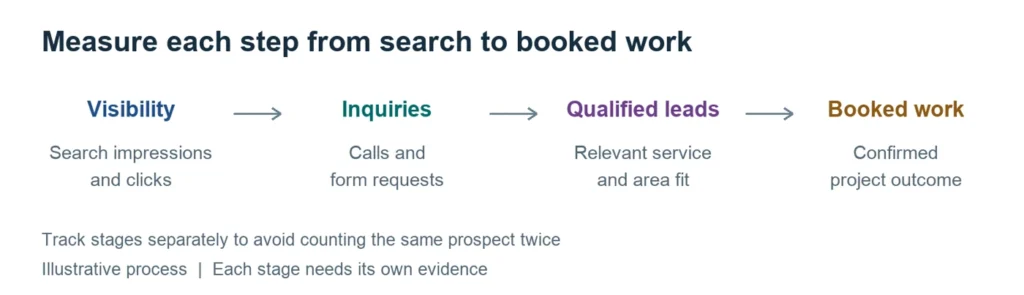
Two free Google tools show the earlier stages. Search Console shows searches, impressions and clicks. Business Profile performance shows calls and website clicks, but it includes activity from Google Ads as well as organic results, and a call click doesn't mean someone answered. The same person can show up in both, so don't add the numbers together and call them leads.
Larger projects can take months to decide, so keep following the outcome after the estimate. Allow for seasons, storms and ad spend before giving SEO the credit or the blame for a change.
What to expect from a contractor SEO agency
A good contractor SEO agency should understand how you win work before it talks about page counts. Ask how it would separate repair calls, remodeling estimates and commercial inquiries, and how that changes its priorities.

Before hiring a construction company SEO agency, ask:
- Which services and customer types would you prioritize, and why?
- How would you handle our service areas without inventing offices?
- What will you change first, and how will you confirm it worked?
- Who writes project and technical content, and what do you need from us?
- How will your report separate visibility, inquiries, qualified leads and booked work?
- What do the fee, scope, account access and cancellation terms include?
You should keep ownership of your domain, website and key accounts. Give the agency access, not control. Google itself warns against anyone guaranteeing a number-one ranking, so treat that promise as a red flag. Our guide on how to choose an SEO agency has more on comparing proposals.
When an agency shows you a case study, ask about the time period, the starting point, the work done and the lead results. Our Watkins Construction case study shows how we approached a Mississippi roofing company with local service pages and link building. Its traffic figures come from Ahrefs, which estimates organic traffic, so they show visibility and not booked jobs. Similar work won't guarantee similar results for another contractor.
Your first 90 days
Month 1: confirm who owns your accounts, choose your priority services and areas, and record how many inquiries you get now. Fix your profile, your contact routes and anything stopping Google from reaching your pages.
Month 2: improve your most important service pages, publish project pages you can verify, and start a steady review routine.
Month 3: look at the inquiries you received. Are people finding the right services? Do the inquiries fit? Where does follow-up fail? Use the answers to choose the next page or fix.
Results vary with your market and starting point, so treat this as an order of work and not a deadline for rankings.
Frequently asked questions
What is contractor SEO?
Contractor SEO is search engine optimization for construction and trade businesses. It helps people find your services through unpaid Google results and your Business Profile, and it aims at relevant inquiries rather than traffic for its own sake.
Can I do contractor SEO myself?
Yes, for a lot of it. You can keep your profile accurate, collect project details, ask for reviews and improve your service pages. Bigger website problems may need a developer or specialist. Start with what you can do consistently, and get help for the gaps.
How much does contractor SEO cost?
There's no single price. It depends on your website's condition, your competition, the number of locations and who makes the changes. Ask for an itemized proposal that lists deliverables and responsibilities so you can compare like with like.
How long does contractor SEO take?
Fixes to your profile and homepage can show up within a few weeks. Ranking in the map pack for competitive searches usually takes several months of steady work, and longer in big metros. Be wary of anyone promising a date for top rankings.
Do I need a separate page for every town?
No. Create an area page only when it helps people in that town understand your services and coverage. A clear list of service areas is enough where a separate page would add little.
How do I choose an SEO agency for contractors?
Choose one that understands your services, explains its work, lets you keep your accounts and reports on real outcomes. Look at what its case study numbers actually measure, and compare scope alongside price.
Start with one service
Pick one service you want to sell in an area you can reliably cover. Check that its page answers a customer's questions, that your profile is accurate, and that an inquiry reaches the right person. That gives you one clear place to start.
If you'd like to know which of these gaps your own business has, look at our local SEO services or request a free audit.